
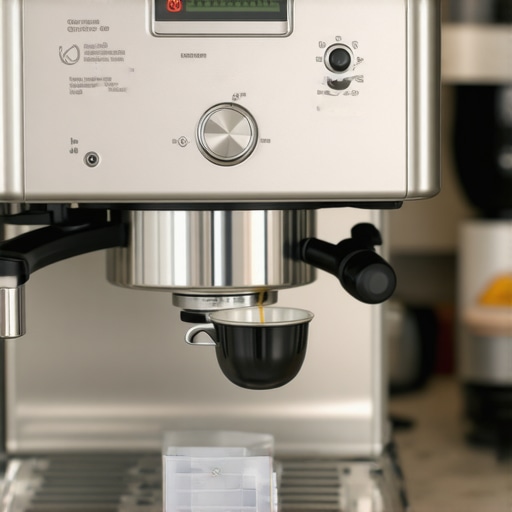
The Best Way to Store Your Portafilter Between Shots
Leaving your portafilter on the countertop is a silent killer of extraction quality. After 15 years of diagnosing thermal drift in luxury kitchens, I can tell you that the cold marble or quartz slab is a heat sink. It siphons energy away from the brass mass of the portafilter, ensuring that your next shot hits a thermal wall. The result? A sour, underdeveloped mess. If you want the sugar browning and viscosity that defines a true God Shot, you must maintain thermal equilibrium. The rule is absolute: the portafilter belongs in the group head. Always. No exceptions.
The science of espresso is fundamentally a battle against heat loss. Most home baristas focus on the boiler, yet ignore the final three inches of the journey. When water leaves a multi-boiler machine that guarantees stable 2026 extraction, it is at a precise 93 degrees Celsius. If that water hits a portafilter that has been sitting on a cold counter for five minutes, the temperature drops instantly by six to eight degrees. This is the thermal shock error that most enthusiasts never see because their PID is lying to them. It shows the boiler temperature, not the puck temperature. You are essentially brewing with lukewarm water while the display glows with a confident 200°F.
The Engineering Reality of Thermal Mass
Metal has a specific heat capacity that dictates how much energy it can store. A standard 58mm chrome-plated brass portafilter weighs nearly half a kilogram. That is a massive amount of material to heat up. If it is cold, it stays cold. When you lock it back into the group head between shots, you allow the machine’s thermal siphon or heating element to keep that metal at the same temperature as the group head. This ensures that the water passing through the puck remains consistent from the first drop to the last. Without this, the front end of your shot will be underextracted, and the tail end might overcompensate. Consistency vanishes. The weight of the industrial grade steel in your hand should be a reminder: this tool is part of the machine, not a separate accessory.
We must also address the operational hazard of moisture. A portafilter left on a towel or a mat traps residual water and old oils against the metal. This is where the smell of rancid coffee begins. By locking it back into the group head—loosely, to avoid crushing the group gasket—you allow the heat to evaporate excess moisture. This keeps the basket dry and ready for the next dose. If you have been struggling with channeling, the issue might not be your grind. It might be the damp basket you are using. You can see the consequences of poor preparation when your portafilter sprays everywhere because the puck didn’t seat properly against a wet surface.
The Stress Test: Gasket Longevity vs. Thermal Stability
I have seen hundreds of group gaskets fail prematurely because owners cranked the handle too hard when storing it. Here is the operational risk: if you lock it in tight while the machine is hot and leave it for eight hours, the heat will bake the rubber gasket into a hard, brittle ring. Eventually, it will leak. You want a light engagement. Just enough to keep it from falling. This allows the heat to transfer through the lugs without flattening the seal. I remember a client in a high-humidity coastal market who insisted on leaving his portafilter in a drawer. Within six months, the chrome began to pit from trapped moisture and the coffee tasted like oxidized copper. The fix was simple: stop treating the portafilter like a spoon and start treating it like a component of the engine.
As we look toward the next 12 to 24 months, we are seeing a shift toward solid-state espresso machines for 0.1C stability. These machines use thick-film heaters directly on the group head. In these systems, storing the portafilter in the group is even more critical because the heat ramp-up is so fast that the portafilter can’t keep up if it starts from room temperature. We are moving away from the 30-minute warm-up times of the past, but the physics of metal remains unchanged. Thermal mass requires contact time.
The Executive Verdict
If you are serious about the quality of your output, you will stop using your countertop as storage. Lock the portafilter into the group head. If you are worried about the gasket, buy a silicone replacement from a reputable trade organization like the Specialty Coffee Association. Silicone handles the heat better than rubber and won’t take a set as easily. My final recommendation for 2026: store it in the machine, keep it clean, and keep it dry. If you are doing a back-to-back session, only remove it to dump the spent puck and reload. Anything else is just inviting variance into a process that demands precision.
FAQ
Should I leave the basket in the portafilter when storing? Yes. The basket needs to be at the same temperature as the portafilter body to prevent the coffee grounds from cooling down instantly upon contact.
Does this apply to bottomless portafilters too? Absolutely. While they have less mass, they are still prone to thermal drift. Keep them in the group.
Will storing it in the group head cause the handle to get too hot? High-quality portafilters use thermal breaks or high-impact plastics in the handle. If your handle is too hot to touch, your group head temperature is likely far too high, potentially indicating a pressurestat failure.
What about during the night when the machine is off? You can leave it in the group, but back off the tension completely. Just let it rest there. This prevents dust from entering the basket and keeps your workflow streamlined for the morning.