
The Best Way to Season Carbon Steel Without the Smoke
Smoke-filled kitchens aren’t a badge of honor for the serious home chef. They are a failure of thermal management. Most guides suggest cranking the oven to 500 degrees and letting the pan bake until your smoke detectors scream and a hazy blue film coats your luxury kitchen ceiling. That method is sloppy. It lacks precision. After fifteen years of handling premium cookware and engineering high-performance kitchen environments, I can tell you that the secret to a glass-like patina isn’t massive heat. It is molecular control. If you want a non-stick surface that rivals Teflon without the carcinogenic trade-off, you must master the cold-start thin-film method. The stakes are high. One wrong move with a high-carbon alloy and you risk permanent warping or a gummy, useless residue that requires a full strip-down.
The Engineering Reality of Carbon Steel
Carbon steel is a reactive material. Unlike 3-ply stainless steel, which relies on a chromium-oxide layer for protection, carbon steel is hungry for oxygen. If you don’t provide a carbon-chain barrier, it will rust within minutes of contact with moisture. The goal is polymerization. This is the chemical process where liquid fats transform into a hard, plastic-like solid. At the molecular level, we are looking for the cross-linking of fatty acids. To do this without smoke, you have to operate just below the smoke point of your chosen fat. High-heat methods accelerate this too quickly, causing the oil to fracture rather than bond. This is why the benefits of hand-forged carbon steel cookware for searing are often lost on those who treat their pans like cast iron. Carbon steel is thinner. It reacts faster. It demands a more sophisticated approach.
Think about the surface of the metal. Under a microscope, it looks like a mountain range. Traditional seasoning fills these valleys with oil. If that oil is too thick, it won’t polymerize all the way through. The result? A sticky mess that flakes off into your eggs. You need a layer so thin it’s practically invisible. We are talking microns. When I consult on luxury kitchen builds, I often see clients buy five-hundred-dollar pans and ruin them in the first hour because they followed a generic YouTube tutorial. Precision is the only way forward.
The Precision Stovetop Technique
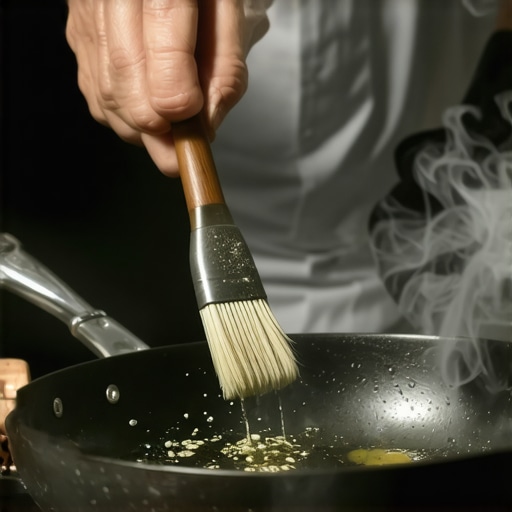
Forget the oven. It is an imprecise tool for this specific task. To season without smoke, you need the localized control of a high-BTU gas burner or a high-wattage induction hub. Start with a bone-dry pan. Place it on medium-low heat. You are not trying to sear a steak; you are trying to open the pores of the metal. Once the pan is warm to the touch, apply a pea-sized drop of grapeseed oil. Now, wipe it off. Use a blue shop towel or a lint-free cloth. Wipe it until you think there is nothing left. This is where most fail. They leave too much oil. The pan should look dry. If it looks shiny, it’s too thick.
Slowly increase the heat. Watch the color. You are looking for a transition from silver to a light straw, then a faint blue. This is the ‘blueing’ stage. If you see even a wisp of smoke, pull the pan off the heat immediately. You are hovering at the edge of the smoke point. By staying just below it for a longer duration, you allow the oil to bond to the iron without breaking down into acrid vapors. This is particularly effective when you season a new carbon steel crepe pan, where the surface area is large and the metal is exceptionally thin. Repeat this process three times. It takes longer. It requires patience. But the finish will be harder and smoother than any oven-baked shortcut.
Oil Selection and Thermal Stability
The choice of fat is a strategic decision. Do not use flaxseed oil. It was the industry darling five years ago, but it is brittle. It flakes. For the technical purist, grapeseed oil or refined sunflower oil are the gold standards. They have high smoke points—usually around 420 to 450 degrees—and a high concentration of polyunsaturated fats. These fats are the building blocks of a durable polymer. If you are dealing with why your carbon steel pan keeps losing its seasoning, chances are you used a fat with too many impurities, like unrefined lard or extra virgin olive oil. These fats burn before they polymerize. They create carbon deposits, not a seasoned finish.
Consider the cost-benefit of your time. Spending forty-five minutes on a slow-heat stovetop season saves you three hours of scrubbing later. It also preserves the air quality of your home. If you have an open-concept kitchen, the last thing you want is the smell of burnt oil permeating your furniture. This is the same logic we apply when we explain why your air fryer is smoking; it is almost always due to fat hitting its flash point and decomposing rather than working for you. In a professional setting, we value efficiency. Efficiency is the absence of waste. Smoke is waste.
Operational Risks and Thermal Shock
The danger is real. Carbon steel has a lower thermal mass than cast iron. If you subject a cold pan to a high-power induction ‘boost’ mode, the center will expand faster than the edges. The result? A ‘spinner.’ Your once-flat pan now has a convex bottom and will never sit flat on glass again. This is an avoidable failure. Always preheat gradually. I have seen countless enthusiasts ruin pro-grade pans because they treated them like industrial machinery instead of precision instruments. Feel the weight of the steel. Listen to the resonance. A well-seasoned pan has a dampened, solid sound. A dry, raw pan sounds tinny.
There is also the risk of acidic intervention. If you spend three hours perfecting your seasoning and then immediately deglaze with white wine, you have wasted your time. The acid will strip the fresh polymer before it has had time to fully cure. In the first week of use, stick to high-fat proteins. Let the fat from the food reinforce the work you did on the stove. This is a long-term play. You are building a legacy of performance, not a quick fix for tonight’s dinner.
Market Corrections and Future Trends
The luxury kitchen market is shifting away from disposable non-stick coatings. We are seeing a resurgence in ‘naked’ metals—carbon steel, wrought iron, and copper. This is driven by both health concerns and a desire for longevity. In the next 24 months, I expect to see more manufacturers offering ‘pre-blued’ pans that have undergone industrial nitrogen-treatment to prevent rust out of the box. However, these will still require a manual season to reach peak performance. The trend is moving toward ‘buy once, cry once’ quality. People want tools that last decades, not years. This shift requires a corresponding increase in user knowledge. You cannot own a Ferrari and take it to a cheap oil-change shop. Similarly, you cannot own premium carbon steel and use primitive seasoning techniques.
Executive Verdict
If you are serious about your kitchen’s performance and air quality, the stovetop thin-film method is the only viable option. It provides a superior non-stick surface without the environmental and sensory cost of a smoke-filled house. If you are currently struggling with a sticky or rusting pan, strip it back with a salt scrub and start over. The strategy: Low heat, micro-thin layers, and oils with high polyunsaturated fat content. Do not rush the process. If you follow this, your pan will outlive you. That is the ultimate ROI.
Frequently Asked Questions
Can I use an induction cooktop for this?
Yes, but you must be careful. Induction heats the metal directly and very fast. Use a low power setting (2 or 3) and increase it slowly to avoid warping the pan.
Why is my pan turning brown instead of black?
Brown is good. It is the first stage of polymerization. A deep black patina takes months of regular cooking. Don’t chase the color; chase the performance.
What do I do if I accidentally create a sticky layer?
You have used too much oil. You can try to fix it by heating the pan and wiping it vigorously while hot, but if it’s too thick, you’ll need to scrub it off with chainmail and start again.
Is carbon steel better than cast iron?
It is different. It is lighter and more responsive to temperature changes, making it better for tossing food and precision searing. Cast iron is better for slow, high-thermal-mass tasks like deep frying.