
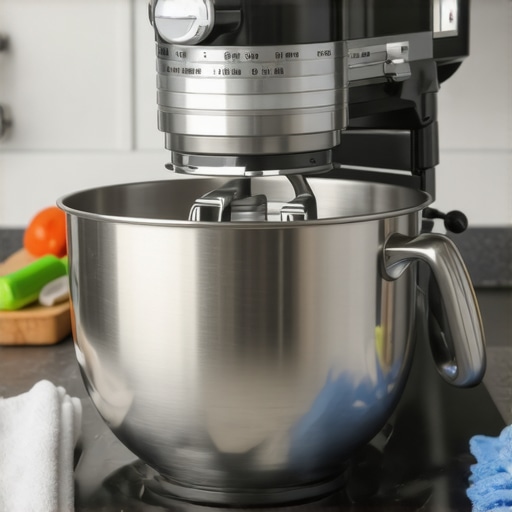
The Best Way to Clean a Burnt Stand Mixer Bowl
Carbonized residue on a professional-grade stand mixer bowl is a structural failure of kitchen maintenance. This is not merely a cosmetic blemish on your luxury kitchen equipment. When sugars and proteins undergo the Maillard reaction and then cross the threshold into full carbonization, they bond with the chromium oxide layer of your stainless steel bowl. Forcing these off with mechanical abrasion is a mistake. I have spent 20 years assessing the damage caused by ‘elbow grease.’ The result? Ruined surface tension and permanent sticking. If you value your stand mixers and premium cookware, you must understand that cleaning is a chemical operation, not a physical one.
The technical reality is that most home cooks attempt to scrub away the problem, which effectively micro-sands the interior of the vessel. This creates ‘teeth’ in the metal. Once those scratches exist, every future batch of dough or meringue will anchor itself into those grooves. We are here to dissolve the bond, not tear it away. Whether you are dealing with a heavy-duty bowl or high-end espresso machines components, the principle remains the same: respect the metallurgy.
The Engineering of Carbon Adhesion
When high-protein batters or high-sugar syrups are subjected to localized heat—often caused by friction when you fail to adjust your stand mixer bowl clearance properly—they undergo a phase change. The material transitions from a liquid or paste into a solid carbon matrix. This matrix is exceptionally good at clinging to the passive layer of 304 or 316-grade stainless steel. In high-performance stand mixers, the torque generated can actually increase the temperature at the point of contact between the dough hook and the bowl base. This is especially prevalent with high wattage stand mixer motors that do not quit when resistance increases.
To break this bond, you need to understand the coefficient of thermal expansion. Stainless steel and carbonized burnt matter expand at different rates. By applying controlled heat via a deglazing process, you create shear stress at the interface of the ‘burn’ and the bowl. This is why a cold scrub is almost always a failure. You are fighting physics with a sponge. Instead, we use alkaline-based dissolution or enzymatic breakdown to weaken the organic polymers holding the carbon to the steel.
Why Mechanical Force Fails
I’ve walked into dozens of kitchens where a $500 mixer set has been decimated by a single pad of steel wool. The screech of metal on metal is the sound of value evaporating. When you use abrasive pads, you are removing the chromium that makes the steel ‘stainless.’ This leads to pitting, which is a localized form of corrosion. You should be as careful with your bowl as you are with the metal choice that prevents pitting in your other high-end vessels. Pitting is irreversible. It creates microscopic caverns where bacteria can thrive and where future burns will originate.
The strategic approach is a ‘soak-and-release’ protocol. This involves using a concentrated base, like sodium bicarbonate or specialized enzymatic cleaners used in the dairy industry. These chemicals cleave the protein chains without touching the metal’s passive layer. If you’ve ever cleaned the heating elements in air fryers, you know the frustration of baked-on grease; the burnt bowl is that problem, but with the added complexity of rotational friction scars.
The Professional Deglazing Protocol
The solution is a three-step chemical release. First, fill the bowl with water and a high-concentration alkaline agent. Heat it indirectly. We are looking for the point where the water molecules can penetrate the porous carbon. Second, introduce a surfactant. This reduces the surface tension of the water, allowing it to get underneath the edges of the burnt patch. Third, utilize a soft polymer scraper. The burnt material should slide off in sheets, not dust.
According to reports by ASM International (The Materials Information Society), maintaining the integrity of the passivation layer is vital for food safety and material longevity. If you find yourself cleaning these bowls frequently, you should also review the proper way to store your stand mixer attachments, as damage to the hooks often leads to irregular friction and subsequent burning during high-speed operation. Consistency in maintenance is the only way to protect your ROI in a luxury kitchen environment.
Market Shifts in High-Torque Mixing
In the next 18 months, we expect to see an influx of mixers featuring ‘smart sensors’ that detect friction heat at the bowl base. Manufacturers are realizing that the ‘set it and forget it’ mentality is destroying consumer hardware. Until those sensors are standard, the burden of protection lies with the operator. We are seeing a move toward ceramic-reinforced coatings, but for the purist, nothing beats bare, polished steel—provided it is handled with technical precision. Regulatory standards from the National Sanitation Foundation (NSF) continue to emphasize the need for smooth, non-porous surfaces to prevent cross-contamination, further making the case against abrasive cleaning methods.
The Executive Verdict
If your bowl is burnt, do not scrub it. If you have already scrubbed it and the surface is dull, you must professionally repolish the interior to restore its non-reactive properties. For everyone else: use a boiling water and baking soda slurry, let it sit for six hours, and use a silicone spatula for removal. This is a ‘Hold’ on aggressive chemicals and a ‘Buy’ on patience and chemical science. The longevity of your equipment depends on your ability to resist the urge to use force.
Frequently Asked Questions
Can I use oven cleaner on a stainless mixer bowl?
Technically, yes, as most are lye-based and will dissolve carbon. However, it is overkill and can dull the exterior finish. Stick to milder alkaline solutions first.
Does the dishwasher fix carbonization?
No. The dishwasher uses high heat to bake the residue further. It’s the worst place for a burnt bowl.
Will vinegar help remove the black marks?
Vinegar is an acid. While it helps with mineral scale, it is less effective against burnt organic matter than alkaline bases like baking soda.