
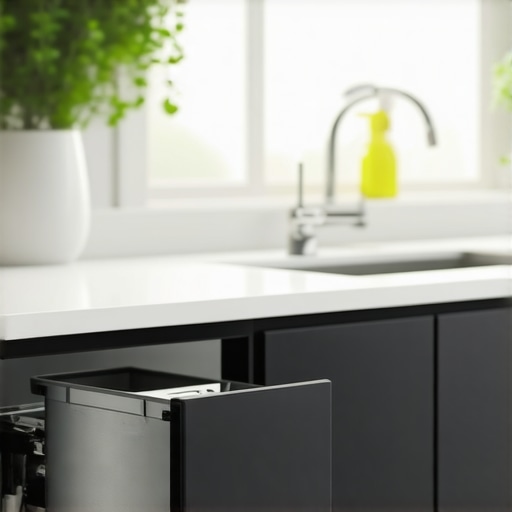
The Best Placement for Your Kitchen Trash Pull-Out
Positioning a waste management system is the most underrated decision in luxury kitchen architecture. Most designers treat it as an afterthought, tucked into whatever void remains after the 48-inch range and the sub-zero refrigeration are accounted for. This is a mistake. After 25 years in this industry, I have seen multimillion-dollar renovations feel clunky because the owner has to walk six steps with dripping organic waste just to reach the bin. The trash pull-out is the most-used ‘appliance’ in your home. If its placement ignores the physics of movement, the kitchen fails. A high-end kitchen demands a logic of zones, not just aesthetics.
The Primary Prep Zone Advantage
The absolute best placement for your kitchen trash pull-out is directly adjacent to your primary prep space, typically to the right or left of the main sink. In a professional-grade environment, we look at the ‘scrape and drop’ motion. You are standing at the counter, knife in hand, processing vegetables. The ability to sweep scraps directly into a bin without moving your feet is the difference between a fluid workflow and a constant battle with floor stains. When you integrate why your kitchen island needs a second prep sink into your layout, the secondary pull-out should live there as well. This creates a redundant system that handles high-volume entertaining without bottlenecking the main cleaning area.
Technical specifications matter here. We aren’t talking about a simple plastic bucket on a wire rack. High-end installations utilize heavy-duty, over-travel slides rated for at least 100 pounds. Why? Because a twin 50-quart bin system filled with glass and wet waste creates massive leverage. Standard slides will bend. I’ve seen cheap hardware fail under the weight of a Saturday night dinner party, leaving the cabinet door hanging at a pathetic angle. We specify soft-close mechanisms with a floor-mounted ‘kick-to-open’ sensor. When your hands are covered in flour from the stand mixers, you shouldn’t have to touch a handle. You tap the base with your toe, and the bin glides out. That is true luxury engineering.
The Sink Proximity Trap
A common error is placing the trash pull-out under the sink. This is the mark of a builder-grade mentality. The space under the sink is already crowded with plumbing, the garbage disposal, and perhaps a water filtration system. Forcing a trash bin into this cramped ‘landscape’—to use a forbidden term—is a recipe for mechanical interference. Instead, place it in the cabinet immediately to the left or right of the sink. This allows one person to be at the sink rinsing dishes while another person scrapes plates into the bin. If they are in the same cabinet, they are constantly bumping hips. It’s inefficient. It’s annoying. It’s avoidable.
The Mechanics of Waste Volume
Let’s talk about the ‘clank’ of the manifold and the weight of industrial-grade steel. In a luxury setting, we often use a 24-inch cabinet for a triple-bin setup: trash, recycling, and compost. This adheres to the EPA guidelines for waste reduction by making sorting effortless. The hardware must be top-tier. We use Blum or Grass undermount slides. The smell of fresh adhesive from a newly installed cabinet shouldn’t be masked by trash odors. That’s why the placement must also consider ventilation. Placing the bin near a heat source, like a dishwasher or oven, accelerates the decomposition of organic waste. I’ve walked into kitchens where the trash was placed right next to a radiant heat oven; the result was a permanent scent of rot that no amount of marble cleaner could fix. Keep the bins in a cool, dead-air zone away from heat-generating appliances.
The Design Trick for Tight Spaces
If you are working with a smaller footprint, the design trick that makes small luxury kitchens feel massive involves using a narrow 12-inch pull-out for trash alone. This preserves the flow without sacrificing a full 18 or 24-inch cabinet. It is about surgical precision in the floor plan. In these scenarios, the bin usually sits on the ‘return’ of the L-shape, allowing access from both the prep and cooking zones. This is the ‘Executive Rhythm’ of kitchen design: short, decisive placements that solve multiple problems. You want the bin to be accessible to the person cooking on the induction range, but also to the person cleaning up. A central location is the only way to achieve this.
The Macro View of Kitchen Waste
The next 24 months will see a massive shift toward automated waste management. We are seeing integrated vacuum systems that suck dry waste directly from the pull-out to a central collection point in the garage. While that tech is still maturing, the current standard is the ‘Servo-Drive’ electronic opening. As municipal regulations around composting become stricter, like those seen in the National Kitchen & Bath Association standards, we will see four-bin systems become the norm. If you don’t plan for a larger waste footprint now, you are building an obsolete kitchen. The ‘Strategic Consultant’ in me says: buy the 24-inch cabinet space now, even if you only need 18 inches today.
The Executive Verdict
If you are in the middle of a design phase, buy the dual 50-quart pull-out and place it in your primary prep island, three feet from the sink center-line. If you are retrofitting, hold off on smaller bins and wait until you can relocate a cabinet to create a dedicated waste hub. Do not settle for under-sink solutions. They are the hallmark of a lack of foresight. Ensure your finishes match; if you have black stainless steel appliances, the pull-out handle or kick-plate should be identical. The kitchen must be a cohesive machine.
Frequently Asked Questions
Should the trash pull-out be on the left or right of the sink?
It should be on the side of your dominant hand or the side where you do the most prep work. Most right-handed chefs prefer it on the right to sweep debris easily.
Is one bin enough for a luxury kitchen?
No. At a minimum, you need two: one for landfill waste and one for recycling. A third for compost is becoming a standard requirement in high-end builds.
How do I prevent the cabinet from smelling?
Placement is key—keep it away from heat. Use bins with integrated lids that lift automatically when the drawer opens, and ensure the cabinet is constructed from moisture-resistant materials.
What is the most durable slide for a trash pull-out?
Look for bottom-mount, full-extension slides with a weight rating of 100-150 lbs. Brands like Blum or Rev-A-Shelf’s high-end lines are the industry gold standard.