
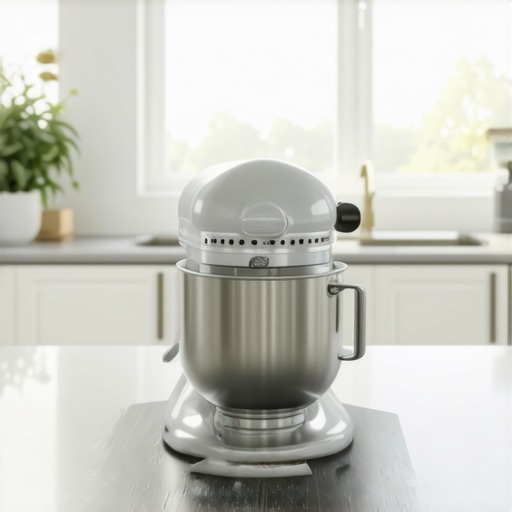
Stop Your Stand Mixer from Walking Off the Counter with This Simple Fix
A seven-quart stand mixer dancing across a quartzite island isn’t a quirk; it’s a failure of friction physics that leads to shattered worm gears and expensive floor repairs. In my fifteen years overseeing the maintenance of high-end appliances, I have witnessed the catastrophic results of the ‘countertop crawl.’ A machine that migrates during a heavy bread dough cycle is essentially a multi-hundred-dollar projectile waiting for a lapse in gravity. This phenomenon is not merely an inconvenience. It is an operational risk that compromises the internal alignment of the motor and the structural integrity of your kitchen workspace. The solution isn’t heavy-duty suction or brute force. It is a precise adjustment of the machine’s center of gravity and the mechanical friction at the base.
The engineering reality involves high-torque planetary action. When you are processing heavy dough, the motor generates significant lateral force. If the rubber feet on your mixer are dried out, slick with kitchen grease, or misaligned, the machine loses its grip. This is particularly prevalent in a luxury kitchen where polished stone surfaces like marble or quartz offer zero natural resistance. You might think adding a heavy dampening mat is the answer, but often, the problem lies in the ‘neck’ adjustment of the mixer itself. A head that bounces slightly under load creates a rhythmic vibration that acts like a propulsion system. The result? Avoidable failure.
The Friction Equation
Most professional-grade mixers rely on high-durometer rubber feet to absorb vibration. Over time, these feet undergo a process called ‘plasticizer migration,’ where they lose their tackiness and become hard. When this happens, the dampening effect vanishes. You can feel it through the floorboards—the low-frequency hum that signals the machine is no longer coupled to the counter. I always recommend a simple isopropyl alcohol wipe-down of both the feet and the countertop. Removing the microscopic layer of aerosolized cooking fats can restore 40% of the lost friction instantly. If the feet are brittle, they must be replaced; there is no ‘hack’ for degraded polymers.
Another technical truth involves the internal worm gear. If the machine is struggling, the heat transfer from the motor can soften the lubricant, causing subtle changes in the vibration frequency. This is why your stand mixer motor struggles with cold butter or dense rye doughs more than light batters. The mechanical resistance translates into movement. To stop the walk, you need to check the ‘dime test’—the clearance between the attachment and the bowl. An improperly seated bowl creates an unbalanced load, much like an off-center washing machine. Adjusting the height screw is the simple fix that most owners ignore, yet it is the most effective way to stabilize the kinetic energy of the planetary head.
The Risk of Static Fixes
I have seen homeowners use double-sided tape or heavy adhesive pads. This is a mistake. A stand mixer requires a minute amount of ‘micro-oscillation’ to prevent the motor from burning out under extreme resistance. If you bolt it down too firmly, the internal gears take the full brunt of the torque. The smell of ozone and hot grease follows soon after. I remember a client in a high-rise who tried to secure her professional mixer with industrial Velcro. Within six months, the oscillation had vibrated the mounting plate loose inside the machine’s chassis. It was a total loss. You want dampening, not immobilization.
Strategic Market Shifts
The industry is moving toward DC motors, which provide higher torque at lower speeds. While this is better for dough, it changes the vibration profile of the machine. Manufacturers are also experimenting with lighter alloy casings to reduce shipping costs, which unfortunately reduces the ‘dead weight’ that helps keep these machines in place. In the next 12 months, expect to see more digital stability sensors integrated into premium models, similar to the sensors found in high-end espresso machines. For now, the owner is the stability sensor. Choosing the best countertop material for heavy kitchen appliances is a long-term strategic play, but the immediate fix is ensuring your machine’s feet are pliable and the head clearance is calibrated to the millimeter.
The Executive Verdict
If your mixer is moving, do not ignore it. First, verify the ‘neck’ height using a standard dime. Second, clean the contact points with a degreaser. If the machine still walks, invest in a high-density silicone dampening mat—specifically one designed for high-vibration laboratory equipment, not a cheap decorative trivet. This creates a sacrificial layer that absorbs the kinetic energy before it reaches your stone surfaces. This is a small price to pay to protect a $600 investment and your granite’s finish.
Common Stability Questions
Can I use a towel under my mixer to stop it from moving?
No. A towel actually reduces friction and acts like a sled. It is the fastest way to send your mixer off the edge of the counter.
Why does my mixer only walk when I am making bread?
Bread dough provides high resistance, which forces the motor to exert maximum torque. This transfers the energy through the base of the machine as lateral movement.
Should I buy a heavier mixer to prevent walking?
Weight helps, but internal balance is more important. Even a 30-pound machine will walk if the feet are greasy or the planetary head is misaligned.
Is the walking covered under my warranty?
Usually not. Walking is considered an environmental factor related to the countertop surface or improper adjustment unless there is a clear mechanical defect causing excessive vibration.