
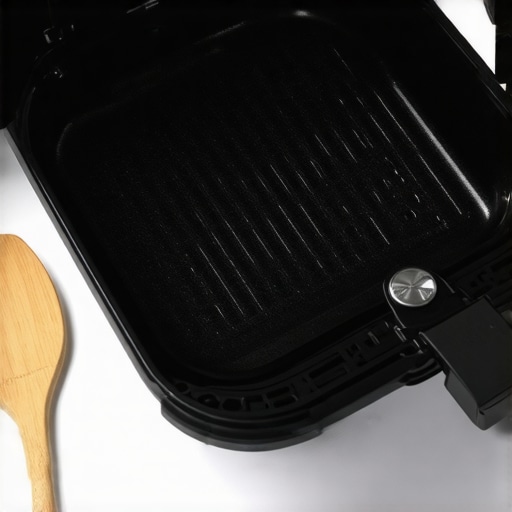
Stop Ruining Your Non-Stick Air Fryer Trays With Metal Utensils
Every morning I walk into my showroom and see the same carnage. A client brings in a high-end air fryer complaining about sticking or uneven cooking. One look at the tray tells the story. It’s been keyed like a disgruntled ex-partner’s sedan. Those silver gouges are not just cosmetic. They represent catastrophic failures of engineering. You paid for a high-velocity convection environment, but you are treating it like a cast-iron skillet from the 1800s. Metal utensils on a non-stick tray constitute an act of appliance sabotage. After running this company for 15 years, I’ve seen thousands of dollars in premium cookware and air fryers trashed because of a five-second convenience. The result? Avoidable failure. Once that PTFE or ceramic bond is broken, the tray is functionally dead. You are no longer air frying; you are fighting physics.
The Molecular Failure of Scratched Trays
Let’s look at the science. Non-stick coatings are usually layers of Polytetrafluoroethylene (PTFE) or reinforced ceramic bonded to an aluminum or steel substrate. The bond depends on surface tension and a pristine, flat topography. When a metal fork or spatula drags across that surface, it creates microscopic canyons. This is mechanical abrasion at its worst. These gouges do more than just let food stick. They create thermal hotspots. Heat no longer radiates evenly across the tray. Instead, it traps in the scratches, causing the surrounding coating to degrade even faster. While why your air fryer needs a dedicated circuit to reach max temp focuses on the power source, the tray is where that energy meets your food. If the tray is compromised, the efficiency drops by 30% or more. You lose that crispiness you paid for. The heat distribution is ruined. It’s a waste of a high-performance machine.
The Economic Reality of Early Replacement
Consider the ROI. A replacement tray for a luxury air fryer can cost between $40 and $90. A set of high-quality silicone-tipped tongs costs $15. The math is simple, yet I see people choose the fork every time. It is a classic case of short-term thinking destroying long-term asset value. In the world of luxury kitchen upgrades, we talk about the cost per use. If your tray lasts three years, your cost per use is pennies. If you ruin it in six months with metal utensils, you’ve effectively tripled the cost of the appliance. We have seen this same pattern in professional kitchens. The chefs who treat their gear with respect have lower overhead. The ones who hack away with metal spend their profits on replacement parts. This is why we insist on silicone or wood. There is no middle ground here.
Why Ceramic Coatings Fail Faster
It is important to note that ceramic coatings fail faster than traditional non-stick when subjected to even minor metal contact. Ceramic is brittle. While it handles high heat better than PTFE, it doesn’t handle impact. A metal whisk or spatula can cause micro-chipping. These chips are often invisible to the naked eye until they start to flake into your food. This brings us to the health aspect. While modern coatings are PFOA-free, you still don’t want to ingest bits of polymer or ceramic. Once the integrity of the surface is gone, the safety profile changes. You also face the risk of rust. Most air fryer trays are made of steel underneath the coating. Once you scratch down to the metal, moisture from your food starts the oxidation process. The result? Rust in your basket. This is the death knell for the tray.
The Silicone Pivot and Material Science
The industry is moving toward high-temp silicone for a reason. It handles up to 500 degrees Fahrenheit without melting and has zero risk of scratching the substrate. This isn’t just about being careful; it’s about using the right tool for the job. If you are using non-toxic air fryer liners, you might think you are safe, but the edges of the tray are still exposed. I’ve seen liners get pushed aside by a metal spatula, leading to a deep gouge on the side walls. According to the Association of Home Appliance Manufacturers (AHAM), mechanical damage is the leading cause of non-stick failure, far exceeding thermal degradation. This aligns with the non-stick coating myth that expensive pans are somehow bulletproof. They aren’t. In fact, the more expensive the coating, the more delicate its precision-engineered surface often is.
Market Corrections and Future Tech
Looking ahead 18 months, we expect to see stricter regulations from the FDA and European food safety agencies regarding the durability of food-contact surfaces. Manufacturers are being pushed to create “scratch-resistant” surfaces, but true scratch-proof non-stick doesn’t exist yet. The second-order effect of this will be a rise in the price of replacement parts as companies try to make trays more durable. This means the cost of your mistake is only going up. We are also seeing a shift toward stainless steel baskets without coatings, but these require a higher skill level to prevent sticking. For the average luxury kitchen owner, the non-stick tray remains the gold standard, provided it is treated with technical respect. Don’t be the person who ruins a $500 machine with a $0.50 fork.
The Executive Verdict
My recommendation is absolute. If it is metal, it stays out of the air fryer. Buy a dedicated set of silicone spatulas and tongs. If your tray already shows signs of flaking or deep silver scratches, replace it immediately. Cooking on a compromised surface is a recipe for poor results and potential health risks. If you are in a situation where you must use metal, you are in the wrong cooking vessel. Move the food to a stainless steel pan. Protect your investment. Maintain the barrier. Eat better food.
Common Questions About Air Fryer Care
Can I use metal if I’m very careful?
No. Even a light touch can create micro-fissures that expand under heat. Is a scratched tray safe to use?
If the coating is flaking or the metal underneath is visible, it should be replaced to avoid ingestion of materials. Do silicone-coated metal utensils work?
Yes, as long as the silicone remains intact and no metal is exposed at the tips. How often should I replace my tray?
With proper care using silicone tools, a tray should last 2 to 3 years. With metal, it may last only months.