
How to Stop Your Air Fryer From Blowing Fuses Every Time
You plug in your new high-wattage air fryer, set it to 400 degrees, and hit start. Ten seconds later, the kitchen goes dark. The result? Avoidable failure. This isn’t just an annoyance; it is a symptom of a fundamental mismatch between modern luxury appliances and legacy electrical infrastructure. After twenty years in the high-end kitchen integration business, I have seen hundreds of homeowners blame the appliance manufacturer when the real culprit is a lack of circuit headroom. Most premium air fryers are effectively industrial-grade resistance heaters. They don’t just use electricity; they demand it with a violence that standard 15-amp circuits cannot withstand. The stake here is not just a cold dinner. Repeatedly tripping a breaker causes thermal stress on the breaker’s internal spring mechanism, eventually leading to a failure where the breaker won’t reset at all or, worse, won’t trip when a real fire hazard occurs.
The Amperage Math
Amperage isn’t a suggestion. It is a hard limit of physics. Most standard residential kitchens are wired with 14-gauge copper wire on a 15-amp circuit breaker. A high-performance air fryer, like those found in our guide to selecting the most efficient air fryers for modern kitchens, typically draws between 1500 and 1800 watts. If we use the standard calculation (Watts / Volts = Amps), an 1800-watt unit at 120 volts pulls exactly 15 amps. This is the absolute maximum the breaker is designed to handle before it heats up and snaps open. In reality, the National Electrical Code (NEC) suggests that a circuit should only be loaded to 80% of its capacity for continuous use. You are redlining your electrical system every time you make crispy wings. If your refrigerator compressor kicks on or you have a toaster on the same line, the breaker has no choice but to kill the power to prevent the wires from melting inside your walls.
Infrastructure Realities
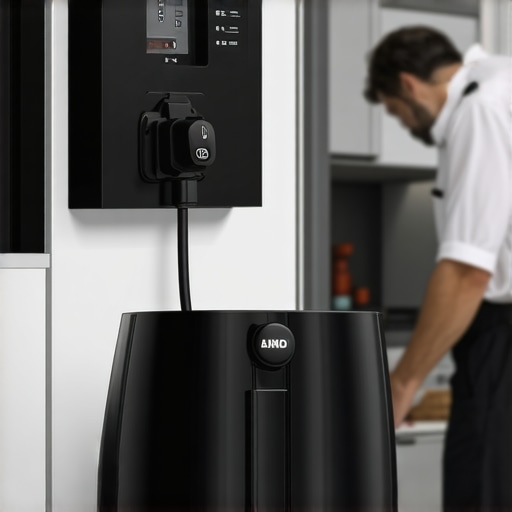
The technical truth that generic AI and superficial blogs miss is the concept of ‘voltage drop’ and ‘inrush current.’ When that heating element first glows, there is a momentary spike in current draw that can exceed the nominal rating. If your home has older wiring, the resistance in those wires causes the voltage to dip, forcing the appliance to pull even more current to meet its power needs. It is a vicious cycle. [image_placeholder_1] This is why I always recommend planning for power outlets on every side of a kitchen island with dedicated 20-amp circuits. A 20-amp circuit uses thicker 12-gauge wire and can handle up to 2400 watts, providing the necessary buffer for high-draw culinary tech. Without this overhead, you are essentially trying to fire a cannon out of a canoe.
The Messy Reality of Circuit Sharing
I recall a client in a luxury high-rise who couldn’t understand why her $400 air fryer kept failing. We spent three hours mapping her kitchen only to find that the developer had daisy-chained the air fryer outlet to the same circuit as the wine cooler and the microwave. The smell of hot copper—that acrid, metallic scent—was already present behind the drywall. We found charred insulation on the outlet terminals. This is the ‘operational risk’ of luxury kitchen design: aesthetics often override engineering. If you hear a ‘clack’ from the panel every time the air fryer reaches temperature, you are damaging the appliance’s sensitive logic boards. Just like the smell of burning motors in high-draw appliances like stand mixers, the heat generated by electrical resistance is the silent killer of kitchen electronics.
Market Corrections and Future Proofing
Looking at the next 24 months, the industry is shifting toward ‘Smart Load Management.’ We are seeing the introduction of intelligent breakers that can prioritize current to specific outlets. However, the most reliable solution remains the ‘Heavy Duty’ approach. If you are renovating, insist on 20-amp T-slot outlets for every countertop station. Local building codes are finally catching up to the reality that a single kitchen circuit cannot power a modern lifestyle. We are moving away from the ‘general purpose’ kitchen circuit toward a model where every high-wattage zone is treated like a dedicated appliance line, similar to a dishwasher or an oven.
The Executive Verdict
Stop using power strips or thin extension cords immediately; they increase resistance and fire risk. If your fryer trips the breaker, you must identify every other device on that circuit and turn them off during the cooking cycle. The long-term strategy is clear: hire a licensed electrician to pull a dedicated 12-gauge line to your primary cooking station. It is a $300 to $500 investment that protects thousands of dollars in appliances and provides peace of mind that no ‘smart’ feature can replace.
Frequently Asked Questions
Q: Can I just swap my 15-amp breaker for a 20-amp one?
A: No. This is a fire hazard. A 20-amp breaker requires 12-gauge wire. If you put a 20-amp breaker on 14-gauge wire, the wire will melt before the breaker trips.
Q: Why does my air fryer only trip the breaker sometimes?
A: It usually depends on what else is running. If your fridge or dishwasher is in a heating cycle at the same time the air fryer is at peak draw, the combined load exceeds the limit.
Q: Is my air fryer defective?
A: Rarely. If the unit works on a different circuit (like in the garage or laundry room), the machine is fine; your kitchen wiring is the bottleneck.
Q: Do smaller air fryers have this problem?
A: Less often. Smaller units typically draw 900-1200 watts, leaving more ‘room’ on the circuit for other devices.