
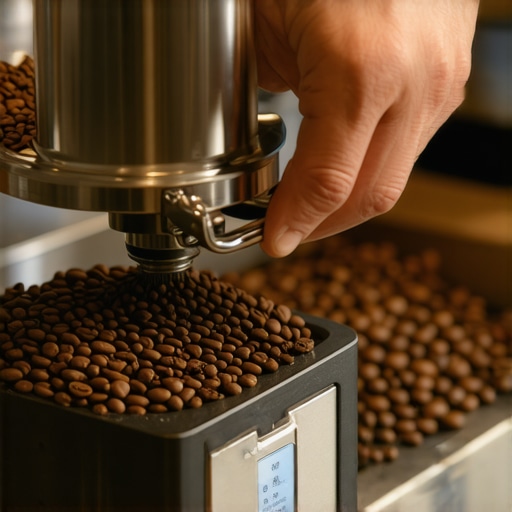
Oily coffee beans are the mechanical nemesis of high-end espresso equipment. While dark, glistening roasts offer the deep chocolate and tobacco notes preferred by many luxury kitchen owners, they present a physics problem that can seize even a $3,000 conical burr grinder. After fifteen years of diagnosing burnt-out motors and clogged chutes, I can state this clearly: you cannot treat an oily bean with the same grind profile as a dry, medium roast. The surface lipids on these beans act as a tacky adhesive. This creates a friction coefficient that standard grinder settings fail to accommodate. The stakes? A ruined pump, a scorched motor, or at the very least, a shot of espresso that tastes like carbonized rubber.
The Physics of Friction
Darker roasts undergo longer pyrolysis, a chemical breakdown that forces internal oils to the surface. When these lipids meet the heat generated by stainless steel or ceramic burrs, they turn into a sludge. This sludge traps fine particulates, creating a feedback loop of clumping. If you maintain a fine grind setting suitable for lighter roasts, you will experience ‘bridging’ where the beans refuse to drop into the burrs. The solution is a strategic coarsening. By moving the grind toward a medium-coarse setting, you reduce the surface area contact and heat generation. This prevents the oil from reaching its melting point during the grinding process. It is vital to how to dial in dark roasts without making them taste like charcoal by prioritizing flow rate over traditional timing. In my experience, the cost-benefit of a coarser grind is obvious: you trade a slight loss in extraction density for a 400% increase in machine longevity. The mechanical stress on the gearbox is significantly lower when the burrs aren’t fighting through a paste.
[IMAGE_PLACEHOLDER]
The Risk of Mechanical Failure
What breaks first? Usually, it is the exit chute. I have seen countless machines where the ‘anti-static’ flap becomes a dam for oily grounds. You hear the motor straining—a high-pitched whine that precedes a dead stop. This is the ‘clank of the manifold’ moment for a barista. If you are using a high-end machine, you must how to calibrate your grinder for a syrupy espresso body while accounting for this viscosity. According to the Specialty Coffee Association (SCA), grind uniformity is the primary driver of quality, but with oily beans, cleanliness becomes the primary driver of consistency. Sensory anchors tell the story: the tacky residue on your fingers after handling the beans is the same residue coating your expensive internals. If you don’t clean the burrs weekly, that oil turns rancid, destroying the flavor of even the most expensive harvests.
Market Corrections and Equipment Shifts
The luxury coffee industry is moving toward high-torque, low-RPM DC motors specifically to combat the heat-related issues of oily roasts. We are seeing a shift in consumer behavior in 2025 where ‘dark’ no longer means ‘charred.’ However, the legacy of French and Italian roasts remains strong in the luxury sector. For those sticking with these traditional profiles, the regulatory reality of home appliance warranties is tightening. Manufacturers are increasingly denying claims for ‘clogging due to improper maintenance,’ making it imperative to the best way to store coffee beans to maintain peak freshness to prevent further oil migration. For a deeper technical perspective, the National Coffee Association (NCA) emphasizes that oxygen exposure accelerates oil rancidity, which in turn increases the stickiness of the bean surface.
The Executive Verdict
If you are committed to oily, dark-roasted beans, your strategy must be proactive. Coarsen the grind by 2-3 notches from your standard espresso baseline. Increase your dry dose by 1 gram to compensate for the coarser texture and maintain puck resistance. Lower your extraction temperature to 190°F (88°C) to avoid pulling the harsh, ashy notes these oils can produce. The result? A balanced, syrupy shot that doesn’t kill your hardware. Stop trying to force a ‘fine’ grind on a ‘thick’ bean. It is a losing battle for your palate and your wallet. stop buying pre-ground coffee for your three thousand dollar machine and learn the tactile feedback of your specific burr set. The smart move is a weekly purge with cleaning tablets to strip the lipids before they polymerize on the steel.
Frequently Asked Questions
Does using oily beans void my grinder warranty? While not explicitly stated by all, many high-end brands like Jura or Breville attribute ‘clogging’ to user error or ‘unsuitable bean types’ in their fine print. Regular cleaning is your only defense.
How can I tell if my grind is too fine for oily beans? If the espresso starts with a few dark drops and then stops, or if the pump sounds muffled and strained, you are choked. Coarsen immediately.
Why does my espresso spray everywhere with dark roasts? This is often due to channeling caused by oil clumps. You likely have a the puck prep mistake that causes your espresso to spray everywhere; use a WDT tool to break up those sticky clusters before tamping.
Are ceramic burrs better for oily beans? Ceramic burrs generally produce less heat than steel, which can help slightly with oil management, but they are more brittle. Steel remains the industry standard for durability.