
The Secret to Professional Microfoam with a Home Steam Wand
Professional microfoam isn’t a byproduct of luck or a high-priced Italian machine. It is a matter of fluid dynamics and protein manipulation. After fifteen years of diagnosing boiler failures and clogged thermoblocks, I’ve seen thousands of home baristas struggle with ‘dish soap’ foam. The problem is almost always a misunderstanding of how steam actually interacts with milk proteins. Most people over-aerate. They introduce too much air, too late, at the wrong temperature. The result? Avoidable failure. Real microfoam is a stable emulsion of air and liquid, held together by the surfactant properties of milk proteins. If your steam wand is just blowing bubbles, you aren’t texturing; you’re just making a mess. You need to master the transition from stretching to rolling before the milk hits the thermal point of no return.
The Physics of Protein Denaturation
When you start steaming, you are performing two distinct tasks: aeration and emulsification. Aeration, or ‘stretching,’ must happen while the milk is cold. Between 40°F and 100°F, the proteins are most receptive to incorporating air without breaking down. If you continue to introduce air once the milk passes 100°F, you will create large, stiff bubbles that refuse to integrate. This is often why your steam wand squeals and produces a dry, chunky texture instead of a glossy sheen. The science is simple. Casein and whey proteins wrap around the air bubbles to stabilize them. At higher temperatures, these proteins denature. They lose their structure. Once that happens, any air you add just creates ‘sea foam’ that sits on top of hot milk. You want a liquid that looks like wet paint. Achieving this requires a precise hand and an even more precise ear. The sound of stretching should be a light, paper-tearing chirp, not a violent splash.
Vortex Logic and Thermal Mass
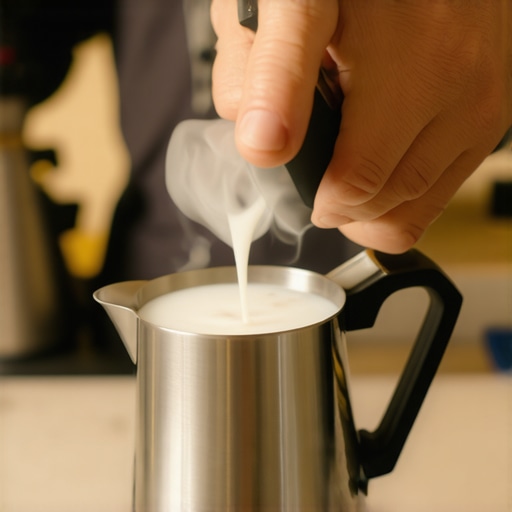
Once you’ve added about 10-15% volume, you must bury the tip. This is where the roll begins. The goal is to create a powerful vortex that pulls the surface bubbles down into the depths of the pitcher, pulverizing them into microscopic spheres. This is the 2-second steam wand trick that separates amateurs from technicians. Position the wand slightly off-center. Angle the pitcher so the milk spins like a whirlpool. If the milk isn’t spinning, the heat isn’t distributing. You’ll end up with a scalded bottom and a cold top. Thermal mass matters here. A heavy stainless steel pitcher absorbs heat, giving you a wider window to work before the milk hits 145°F. Beyond 160°F, the lactose begins to burn. The sweetness vanishes. You are left with a flat, bitter liquid that ruins even the best beans. Many baristas now look toward 4 solid state espresso machines for 0.1c stability 2026 to ensure their steam pressure remains constant throughout this entire window. If the pressure drops mid-roll, the vortex collapses. The texture dies.
Boiler Limitations and Vapor Quality
Home machines often suffer from ‘wet steam.’ This is steam with a high water content. Wet steam dilutes your milk and makes it impossible to achieve that heavy, silky mouthfeel. To fix this, you must purge the wand aggressively before starting. Clear the condensation until you see nothing but invisible, dry gas. If your machine has a small boiler, you are fighting against rapid pressure decay. You must start steaming as soon as the heater light turns off, or even slightly before, to ‘trick’ the element into staying on during the process. Neglecting your machine’s health also plays a role. I have seen countless boilers fail because owners ignored mineral buildup. Remember that hard water kills expensive espresso machines, and a scaled-up heating element cannot produce the dry, high-velocity steam required for professional results. The vibration in the handle should be steady; any sputtering is a sign of internal scaling or a failing solenoid valve.
The Engineering Reality
We are seeing a shift in how home equipment is built. In the next 12 to 24 months, the market will move away from traditional thermoblocks toward high-wattage induction steam generators. These provide instant, dry vapor without the wait time. However, the manual skill of creating a vortex remains the bottleneck. You can have a ten-thousand-dollar setup, but if your tip depth is wrong by two millimeters, your latte art will fail. The industry is also seeing more focus on 4-hole steam tips, which distribute energy more evenly than the single-hole tips found on entry-level machines. This change forces a faster workflow. You have less time to stretch. You have to be decisive. Use a bottomless portafilter to ensure your espresso shot is ready first; milk waits for no one. Once the steam stops, the bubbles begin to separate. You have approximately thirty seconds to pour before the emulsion breaks.
The Executive Verdict
If you want cafe-quality milk at home, stop focusing on the froth and start focusing on the spin. Purge the wand. Stretch for three seconds. Roll until the pitcher is almost too hot to touch. If your current machine feels weak, check for scale. If you are in the market for an upgrade, prioritize boiler size and steam tip geometry over ‘smart’ features that don’t affect the cup. Consistency is the only metric that matters in a luxury kitchen.
Frequently Asked Questions
Why is my milk always bubbly instead of smooth?
You are likely stretching the milk for too long or not creating a strong enough vortex to incorporate the air. Air should only be added while the milk is cold.
Does the type of milk matter for microfoam?
Yes. Whole milk has the best balance of fats and proteins for a stable emulsion. Alternative milks like oat require a different temperature profile because their proteins denature faster.
How do I know if my steam is ‘wet’?
If you purge the wand and see constant dripping or a heavy mist rather than a clear, powerful jet of gas, your steam is too wet for high-end microfoam.
Should I use a thermometer?
Initially, yes. You need to calibrate your hand to recognize what 140°F feels like. Eventually, you should rely on the heat through the pitcher for better timing.
“, “image”: {“imagePrompt”: “Macro shot of a high-end stainless steel steam wand submerged in a milk pitcher, creating a perfect white vortex of microfoam, steam rising in a luxury kitchen, soft bokeh background, 8k resolution.”, “imageTitle”: “Professional Steam Wand Microfoam Technique”, “imageAlt”: “A close-up of a steam wand creating a vortex in a milk pitcher for microfoam.”}, “categoryId”: 7, “postTime”: “2025-05-20 10:00:00”}
Comments are closed.