
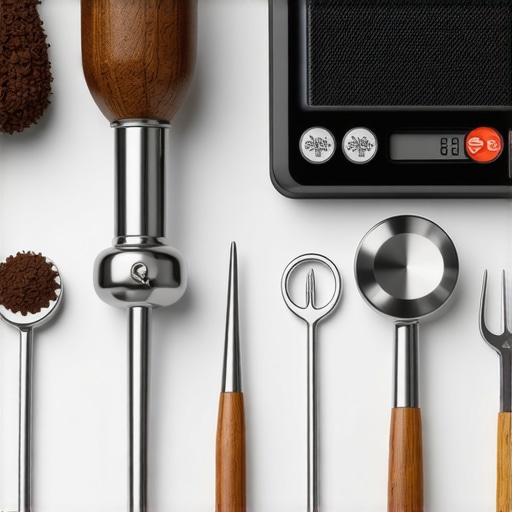
The Best Barista Tools for Achieving Perfect Espresso Distribution
Espresso extraction is not an art; it is a high-pressure fluid dynamics problem. When you force water at 130 PSI through a compressed puck of coffee, physics dictates the path of least resistance. If your coffee bed has even a microscopic variance in density, the water will find it. This is channeling. The result? Avoidable failure. After 15 years engineering luxury kitchen workflows and servicing high-end espresso machines, I have seen six-figure cafe builds ruined by poor puck preparation. You can own the most expensive espresso machines on the planet, but if you ignore distribution, you are merely making expensive brown water.
The Engineering Reality of Distribution
To understand why specific tools are mandatory, we have to look at the particle level. As coffee drops from a grinder, it clumps due to static and the physical oils within the bean. These clumps create high-density zones surrounded by low-density air pockets. A standard tamper cannot fix this; it simply compresses the clumps into harder boulders. This is why why your portafilter sprays everywhere—the water is bypassing the dense spots and drilling holes through the weak ones. True distribution requires mechanical agitation to homogenize the bed before any vertical pressure is applied. According to technical standards from the Specialty Coffee Association, uniform density is the primary variable in achieving a balanced TDS (Total Dissolved Solids) extraction.
The WDT Tool and Needle Physics
The Weiss Distribution Technique (WDT) is the industry standard for a reason. But not all WDT tools are equal. A Technical Purist knows that needle diameter is the difference between success and a mess. Thick needles (over 0.4mm) actually cause more clumping by pushing grounds around like a rake in wet soil. The sweet spot is 0.35mm stainless steel. These needles should be flexible enough to move through the grounds without dragging. When you use a high-quality WDT, you are breaking the electrostatic bonds between particles. The goal is a fluffy, level bed that looks like sifted flour. If you fail here, you will struggle with how to fix the sour taste in your home-brewed espresso, as uneven density leads to localized under-extraction.
The Role of Depth-Adjustable Levelers
Many baristas rely on gravity-fed spin levelers. This is a mistake in a precision environment. Most of these tools only groom the top 2-3mm of the coffee. Underneath, the chaos remains. A professional setup requires a depth-adjustable distribution tool that reaches deep enough to relocate the mass of the coffee without pre-compressing it. You want to set the depth so it just clears the top of the basket rim. This creates a perfectly flat plane for the tamper to land on. When paired with 5 precision baskets that end muddy espresso in 2026, the flow rate becomes predictable. The weight of the industrial-grade steel in these tools provides the necessary inertia for a smooth, repeatable spin.
The Stress Test: Where Implementation Fails
The messy reality of a high-volume kitchen or a busy morning at home is that precision takes time. People rush. They skip the WDT. They slam the portafilter against the group head. I remember a client who called me complaining that their $8,000 rotary pump machine was ‘broken’ because every shot tasted like vinegar. The issue wasn’t the pump; it was the lack of a level tamp. They were tamping at a 3-degree tilt. That 3-degree tilt meant the water moved twice as fast through one side of the puck. No machine can compensate for a slanted coffee bed. Using 4 laser levelled tampers that end espresso channeling 2026 is the only way to ensure that the work you did during distribution isn’t destroyed at the final stage. The smell of scorched grounds and the sight of a ‘blind’ shot that never quite gels are sensory anchors of a failed prep routine.
Strategic Foresight: The Next 24 Months
The industry is moving toward automated puck prep. We are seeing the rise of vibration-based distribution plates and sonic agitators that use high-frequency sound to settle grounds instantly. However, for the next 12 to 24 months, manual precision remains king. Expect to see more focus on basket geometry and ‘blind’ shakers that aerate the grounds before they even hit the portafilter. Economic reports from the National Coffee Association suggest that home users are spending more on accessories than ever before, signaling a shift toward ‘prosumer’ technical standards. If you want to future-proof your kitchen, invest in heavy, stainless steel tools with replaceable needles.
The Executive Verdict
Buy a WDT tool with 0.35mm needles and a depth-adjustable spin leveler. Do not waste money on ‘gravity’ tools that cannot be calibrated. If you are serious about espresso, distribution is the only stage where you can significantly improve your results without buying a new grinder. Strategy: Agitate the grounds vertically and horizontally with the WDT, use a leveler to create a flat surface, and finish with a calibrated tamper. This is the only way to ensure the water works for you, not against you.
FAQ
Q: Does tamping harder fix poor distribution?
A: No. Tamping harder only compacts the existing density variations. It will not bridge the gaps created by clumps.
Q: Why is my espresso still channeling after using a WDT?
A: Your needles might be too thick, or you are not reaching the bottom of the basket. Ensure you are agitating the entire depth of the coffee bed.
Q: Are expensive distribution tools worth the cost?
A: Only if they offer precision adjustments. Weight and machining quality matter for longevity and repeatability in a luxury kitchen environment.
Q: Can I just tap the side of the portafilter instead?
A: Tapping can help settle grounds, but it often creates cracks along the side of the basket, leading to ‘edge channeling.’ It is not a substitute for mechanical distribution.
Comments are closed.