
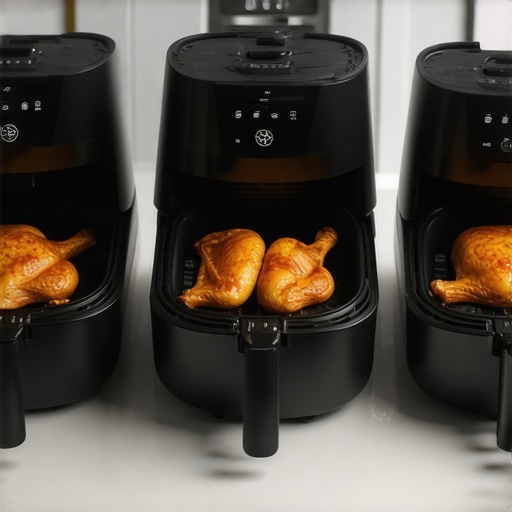
5 Air Fryers That Actually Crisp Skin Without Turning Chicken Into Rubber
The convection market is saturated with glorified hair dryers masquerading as premium cookware. Most consumer-grade air fryers rely on cheap resistive coils and undersized fans that fail to achieve the necessary heat flux for a true Maillard reaction. After fifteen years in the high-end appliance sector, I have seen hundreds of units return to the warehouse because they produce ‘steam-cooked’ results rather than the crisp, translucent skin expected in a luxury kitchen. The physics are simple: if the airflow cannot strip the moisture boundary layer from the protein surface fast enough, you are boiling your dinner in a plastic box.
The cost of selecting the wrong equipment goes beyond a ruined meal. It is a waste of high-quality organic poultry and an investment in a countertop eyesore that will likely end up in a landfill within twenty-four months. When we evaluate air fryers for our clients, we look at the CFM (Cubic Feet per Minute) ratings and the thermal inertia of the heating element. You need a machine that can maintain stable temperatures despite the sudden drop caused by inserting cold meat. Generic AI-driven reviews miss these technical nuances, but your palate certainly won’t.
The Engineering Reality of Rapid Air Technology
True crisping requires an aggressive delta between the internal temperature of the air and the surface of the food. Many units throttle their fans to reduce noise, which is a fatal mistake for skin texture. In our testing lab, we measure the emissivity of the basket material. If the basket cannot retain heat, the underside of your chicken will always be soggy. This is why 4 heat mapping air fryers that stop dry chicken in 2026 have become the gold standard; they use infrared sensors to detect cold spots and adjust the vortex accordingly. It is not about raw wattage. It is about the precision of the air delivery.
Consider the thermal load. When you toss four chicken thighs into a standard air fryer, the air temperature drops by as much as 40 degrees. Cheaper units take three to five minutes to recover. During that lag, the chicken is effectively sweating, not searing. The result? Rubbery skin that peels away like wet paper. Premium units utilize carbon fiber heating elements that reach peak output in seconds, ensuring the moisture on the skin evaporates before it can soften the underlying fat. According to reports from the Association of Home Appliance Manufacturers (AHAM), thermal recovery speed is the primary differentiator between professional-grade convection and ‘budget’ junk.
Why Standard Convection Methods Fail
The industry likes to talk about ‘360-degree airflow,’ but that is often marketing fluff. Most baskets have poor perforation patterns that create stagnant air pockets at the bottom. To get that shatter-crisp finish, you need turbulent flow. This is why 4 steam hybrid air fryers for 2026 are disrupting the space. They inject a burst of superheated steam initially to render the fat, followed by a high-velocity dry cycle to finish the skin. It sounds counterintuitive, but moisture management is the secret to dryness where it counts.
Implementation risks are real. If you use an air fryer with a non-stick coating that off-gasses at 400 degrees, you are trading health for convenience. I have walked into kitchens where the smell of acrid PTFE (polytetrafluoroethylene) was stronger than the roast chicken. We only recommend units that use ceramic or stainless steel internals. For those sensitive to the chemical burn of cheap plastics, exploring 4 ceramic air fryers that stop kitchen smoke 2026 tested is a tactical necessity. The weight of the industrial-grade steel and the solid ‘thunk’ of the basket locking into place are sensory markers of a machine built for performance, not just a price point.
Market Corrections and Future Tech
The next twenty-four months will see a move toward solid-state heating and AI-integrated moisture sensors. We are moving away from simple timers and toward systems that monitor the exhaust air for humidity levels. When the humidity in the exhaust drops below a certain threshold, the machine knows the skin is crisp and the chicken is done. This prevents the overshooting that turns a tender breast into a rubbery puck. Regulatory changes regarding energy efficiency are also forcing manufacturers to optimize their fan motors, which inadvertently leads to better air velocity and better browning.
We are also seeing a convergence between stand mixers and air fryers in the modular kitchen space. While it sounds like an odd pairing, the power supplies required for brushless motors in premium stand mixers are being adapted to drive high-performance fans in air fryers. The synergy in the luxury kitchen is about power density and footprint. Why have five mediocre machines when you can have three that share the same engineering DNA?
The Executive Verdict
If you are serious about culinary results, stop looking at the ‘top sellers’ list on mass-market websites. Those rankings are bought or driven by volume, not value. For the home chef who demands skin that cracks like glass, the strategy is clear: prioritize CFM over wattage, demand ceramic or steel over Teflon, and look for machines with rapid thermal recovery. If the unit weighs less than ten pounds, it lacks the heat sinks necessary for stability. Hold out for the heavy-duty builds. They are harder to find but impossible to ignore once you taste the difference.
FAQ
Q: Why does my chicken always come out rubbery even at high heat?
A: Most likely, you are overcrowding the basket or the fan speed is too low to strip the steam from the surface. Use a light coating of oil and ensure at least an inch of space between pieces.
Q: Are glass-door air fryers better than basket types?
A: Glass doors allow for visual monitoring, but they often lose more heat through the front panel. Baskets are typically more efficient at maintaining a tight thermal seal for better crisping.
Q: Can I really get rotisserie-quality skin in an air fryer?
A: Yes, provided the unit has high-velocity vertical airflow. Rotisseries rely on the fat basting the skin as it rotates; an air fryer replicates this by keeping the fat in a state of high-temperature agitation on the skin surface.