
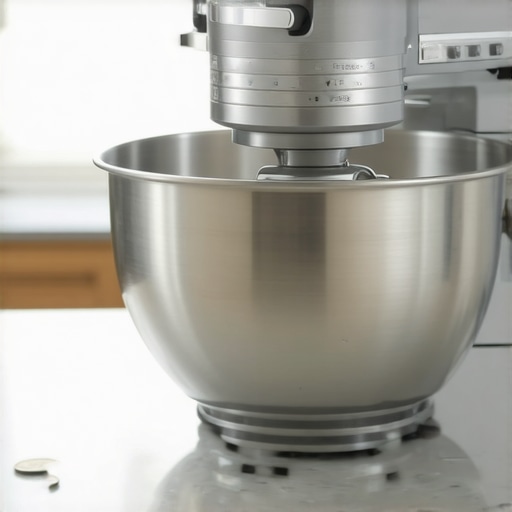
The Simple Dime Test That Stops Your Stand Mixer From Chipping the Bowl
The sound of a beater scraping stainless steel isn’t just an annoyance. It is the audible death rattle of your motor and the contamination of your product. If you see white flakes in your sourdough or grey streaks in your meringue, you have already failed the baseline of culinary engineering. Most home bakers assume a chipping paddle is a manufacturing defect. It isn’t. It is a calibration error. After 15 years of diagnosing planetary gear failures and stripped worm gears, I can tell you that 90% of stand mixer damage stems from a clearance gap that drifted by less than two millimeters.
The stake here is high. We are talking about the structural integrity of your internal drive train. When the beater hits the bowl, it creates a momentary stall in the motor. This spike in resistance generates heat that fries control boards and shears nylon gears. If you are using metal gear stand mixers that won’t overheat, the damage might move to the bowl itself, leading to microscopic metal shavings in your food. Precision is not optional.
The Engineering Reality of Clearance
Every planetary mixer relies on a specific distance between the bottom of the attachment and the base of the bowl. This is the ‘beater-to-bowl’ clearance. If it is too high, you get a dead zone of unmixed flour. Too low, and you are literally sanding down your equipment. The dime test is the industry standard for recalibrating this gap without specialized calipers. You drop a standard U.S. dime into the bowl, turn the mixer to speed 1, and watch. The beater should nudge the dime about half an inch every rotation. If the dime doesn’t move, you’re too high. If it’s being dragged around the entire circumference, you’re hitting the deck.
The result? Avoidable failure. I have seen machines with heavy duty stand mixers that handle triple batches literally crack their tilt-head hinges because the upward pressure from the beater hitting the bowl base was so intense. This isn’t just about the bowl; it’s about the physics of energy transfer. [IMAGE_PLACEHOLDER]
Why Standard Methods Fail Under Load
Most manuals tell you to adjust the screw behind the tilt head. They don’t tell you that the adjustment changes once the bowl is full. Physics dictates that 5 pounds of heavy dough will pull the head downward, narrowing your carefully set gap. This is why a static test is only the beginning. You need to account for ‘head play.’ If your mixer ‘walks’ or shakes, that clearance is constantly fluctuating. For high-volume environments, I often recommend pressure mapping stand mixers to see how the motor load actually shifts during the gluten development phase.
There is also the matter of thermal expansion. As the motor heats up, the metal shaft can expand. A gap that looks fine in a cold kitchen might disappear after twenty minutes of kneading brioche. If you aren’t using solid state stand mixers, your heat management is likely subpar, making the dime test even more critical for long-term durability.
Market Corrections and Future Tech
We are seeing a shift toward magnetic drive stand mixers which eliminate the traditional planetary shaft entirely. These units use sensors to maintain clearance in real-time, effectively automating the dime test. However, for those of us clinging to our mechanical workhorses, manual calibration remains the only defense against the scrap heap. In the next 24 months, expect to see more ‘smart’ accessories that alert you via haptic feedback when beater friction is detected. Until then, your ears and a ten-cent coin are your best tools.
The Executive Verdict
If you own a tilt-head or bowl-lift mixer, perform the dime test every three months. If you move the mixer to a different counter, do it again. Vibration from transport can loosen the adjustment screw. If your beater is already chipped, stop using it. The exposed metal will oxidize and ruin your flavor profiles. Buy a new coated or stainless steel beater, calibrate the machine, and lock the screw with a drop of food-grade thread locker. Buy into the habit of precision; Sell the idea that ‘close enough’ works for high-torque appliances.
FAQ
Does a nickel work for the test? No. A nickel is 1.95mm thick, while a dime is 1.35mm. Using a nickel will leave too large a gap, leading to poor incorporation at the bottom of the bowl.
What if my mixer doesn’t have an adjustment screw? Some entry-level models use fixed pins. In those cases, the only solution is to ensure the bowl is seated perfectly or to check for a bent beater shaft.
Why is my beater still hitting the sides even after adjustment? This usually indicates a worn-out planetary washer or a loose ‘neck’ pin. It requires a deeper mechanical teardown to tighten the internal housing.
Comments are closed.