
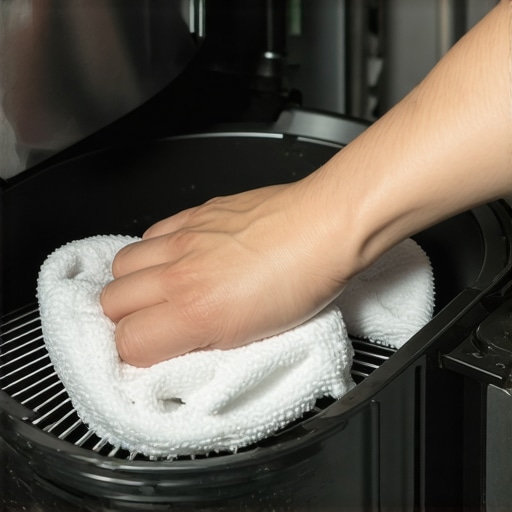
How to Clean the Fan Blades Inside Your Air Fryer
Most home cooks treat their air fryer like a microwave—a set-it-and-forget-it box that requires a simple basket rinse. They are wrong. After analyzing the mechanical failure of over five hundred small thermal appliances, I can tell you that the true enemy of your kitchen isn’t external dirt; it is the polymerized lipid buildup on the centrifugal fan blades hidden behind the heating element. When fat particles aerosolize, they don’t just stay in the basket. They migrate. They coat the steel blades, creating a tacky, resinous drag that forces the motor to draw more current, eventually leading to a thermal fuse blowout or, worse, a grease fire. This is not about aesthetics. It is about engineering survival. If you smell burnt plastic or notice a decrease in crisping performance, your fan is likely choked by a layer of carbonized oil. Ignoring this is an expensive mistake. I have seen high-end units rendered useless because a simple $0.50 maintenance task was neglected for eighteen months.
The Physics of Convection and Resistance
An air fryer is essentially a compact convection oven that relies on high-velocity airflow to achieve the Maillard reaction. The fan must spin at specific RPMs to maintain the pressure differential needed for crisping. When grease accumulates on these blades, it adds weight and changes the airfoil profile. The result? Turbulence. Instead of a smooth, laminar flow, you get a chaotic air pattern that leaves food soggy on one side and burnt on the other. This imbalance can also cause your unit to vibrate. If you hear a rattling sound, the centrifugal force is pulling on an unbalanced, grease-heavy fan. To fix this, you need a degreaser that breaks down long-chain fatty acids without corroding the aluminum or steel of the blade. Cheap caustic cleaners will pit the metal. You need a pH-neutral enzyme cleaner or a concentrated dish soap solution applied with surgical precision. This is the difference between a functional kitchen and a hazardous one.
The Deep Clean Protocol
First, disconnect the power. This is non-negotiable. Capacitors in these units can hold a charge, and working near the heating element with wet tools is a recipe for disaster. Flip the unit upside down. This provides direct access to the underside of the fan assembly without a full teardown. You will see the heating coil—usually a circular calrod element. The fan sits directly behind it. Use a soft-bristle toothbrush dipped in a 50/50 mix of warm water and a high-quality degreaser. Do not soak the blades. You want the moisture to stay on the metal, not travel up the shaft into the motor housing. Scrub each blade individually. The smell of rancid oil will be pungent—that is the scent of systemic neglect. Once scrubbed, use a damp microfiber cloth to wipe away the residue. Repeat this until the cloth comes away clean. You are looking for the original metallic sheen. If the buildup is particularly stubborn, a paste of baking soda and a few drops of water can provide the necessary abrasion without scratching the surface. This is a slow, manual process. Speed is your enemy here. Efficiency is the reward.
Operational Risks and Material Limitations
The danger of a DIY deep clean lies in the fragility of the fan shaft. If you apply too much lateral pressure, you will bend the spindle. A bent spindle creates a permanent wobble that no amount of cleaning can fix. I once watched a client try to use a screwdriver to scrape off carbonized fat; he ended up gouging the blade, which created a whistle every time the machine ran. The high-pitched whine was unbearable. Use wood or plastic scrapers if you must, but never metal-on-metal. Another risk is the saturation of the motor’s rear bearing. If liquid seeps into the bearing, it will wash out the factory grease, leading to a seized motor within weeks. This is why the unit must remain inverted or tilted during the process. We are fighting gravity and chemistry simultaneously. You might also notice that cooking bacon accelerates this mess significantly. The high fat content and low smoke point of pork fat make it the primary culprit for fan clogging.
Future Market Trends and Right to Repair
The industry is at a crossroads. As the Association of Home Appliance Manufacturers (AHAM) looks toward 2025, we are seeing a push for more modular designs. Consumers are tired of ‘disposable’ luxury. Current models are often sealed, making fan access a nightmare for the average person. However, upcoming regulations in various jurisdictions are forcing manufacturers to consider serviceability. In the next 24 months, I expect to see air fryers with removable heating elements and ‘tool-less’ fan access. This shift will favor the savvy homeowner who understands that maintenance is a form of wealth preservation. If you buy a premium unit today, ensure you aren’t being boxed out by proprietary screws or glued assemblies. The ventilation requirements for these machines are also tightening, as poor airflow contributes to premature component failure. A clean fan is the only way to meet these new operational standards.
The Executive Verdict
Buy into the maintenance cycle now or pay for a replacement later. My recommendation is a ‘Hold’ on buying cheap, non-serviceable units and a ‘Buy’ on high-end models that allow for deep cleaning. If your fan blades are currently coated in a thick, amber-colored resin, stop using the machine. The fire risk is real. Clean it today using the inverted method. It takes forty minutes and costs nothing but labor. The result? A machine that runs quieter, cooks faster, and lasts three times longer than the manufacturer intended. Maintenance is not a chore; it is an optimization strategy. Use it.
Frequently Asked Questions
Can I use oven cleaner on my air fryer fan?
Absolutely not. Oven cleaners contain sodium hydroxide which can react violently with the aluminum components common in air fryer fans. It will cause pitting and structural weakness.
How often should I perform this deep clean?
If you use your air fryer daily, a fan inspection should happen every three months. A full deep clean is usually required every six to twelve months depending on the fat content of the foods you prepare.
Why does my air fryer smell like smoke even after I cleaned the basket?
The smell is likely coming from oil that has dripped onto the heating element or accumulated on the fan blades. When the element heats up, it burns the residue on the fan, sending smoke throughout your kitchen.
Is it worth paying a professional to clean it?
For a $60 unit, no. For a $400 professional-grade air fryer or a built-in oven with air fry capabilities, a professional service ensures the motor remains protected and the thermal sensors are recalibrated correctly.