
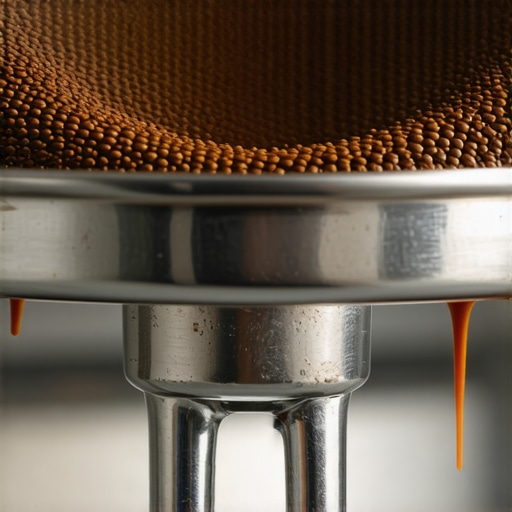
Why Your Espresso Portafilter Is Squirting Everywhere
A messy espresso shot is more than a morning annoyance; it is a definitive hydraulic failure. When you see those aggressive jets of liquid spraying from your bottomless portafilter, you are witnessing high-pressure water finding the path of least resistance through a compromised coffee puck. After fifteen years of diagnosing high-end extraction systems, I can tell you that the machine is rarely the villain. The culprit is almost always the physics of the puck. Ignoring these sprays results in uneven extraction, wasting expensive beans and potentially masking deeper issues with your group head maintenance. High-pressure water—a relentless force—will exploit even the microscopic gaps in your distribution. The result? Avoidable failure.
The Engineering Reality of Hydrostatic Pressure
To understand the ‘squirt,’ you must understand Darcy’s Law. In a closed system, fluid flow is proportional to the pressure gradient and the permeability of the medium. When you lock that portafilter into a prosumer machine, you are asking the pump to force water through a compressed bed of coffee at roughly 130 PSI. If the density of that bed is inconsistent, the water won’t move through it evenly. It will find a ‘channel.’ These channels act like high-velocity bypasses. As the water rushes through these gaps, it picks up speed, exits the basket as a pressurized jet, and sprays your pristine luxury kitchen backsplash. This is fundamentally a puck prep mistake that ruins the flavor profile by over-extracting the channel and under-extracting the rest of the puck. In the world of premium cookware and high-end espresso machines, precision is the only currency that matters. You wouldn’t expect a stand mixer to handle dense dough with a loose whisk, so don’t expect a poorly tamped puck to handle 9 bars of pressure.
Fluid Dynamics and the Role of Interstitial Gaps
The technical truth that most casual users miss involves burr geometry and particle distribution. If your grinder produces a wide range of particle sizes—known as a high bimodal distribution—the smaller ‘fines’ can migrate to the bottom of the basket, clogging the holes. This increases backpressure and forces the remaining water to erupt through any structural weakness in the upper layers. This isn’t just about the coffee; it is about the equipment’s synergy. A high-end setup with air fryers and integrated appliances requires a holistic approach to maintenance. Sometimes, the spray isn’t from the puck at all but from a failing gasket. You should check the hidden seal that makes your espresso machine leak from underneath to ensure the pressure is truly contained within the basket. The smell of scorched rubber or the sound of hissing steam often precedes a total seal failure.
Operational Risks of Ignoring Channeling
Leaving the spray unaddressed carries significant second-order effects. Beyond the mess, you are subjecting your machine to inconsistent backpressure. For those using heat-exchange or dual-boiler systems, these fluctuations can lead to thermal instability. I’ve seen prosumer machines develop premature wear on their three-way solenoid valves because of the erratic pressure spikes caused by catastrophic channeling. According to standards established by the Specialty Coffee Association (SCA), consistent extraction is the baseline for quality. When the water temperature fluctuates because of uneven flow, the chemical composition of your shot changes. You can read more about how water temperature fluctuates during these events. The weight of the industrial grade steel in your portafilter won’t save you if the internal chemistry is wrong.
Market Corrections and the Prosumer Shift
The industry is moving toward total transparency. In the next 12 to 24 months, we expect to see more ‘smart’ baskets that use flow-rate sensors to alert the user to channeling before the shot even finishes. This mirrors trends we see in other luxury kitchen tech, like air fryers with internal cameras or stand mixers with integrated scales. Consumers are no longer satisfied with ‘good enough.’ They want data-driven results. This shift means that manual skills, like WDT (Weiss Distribution Technique) and precision tamping, are becoming the standard, not the exception. The coffee quality standards defined by the Coffee Quality Institute (CQI) are now being applied at the home counter. If your equipment isn’t calibrated, you are essentially driving a supercar on a dirt road.
The Executive Verdict
If your portafilter is squirting, my recommendation is a ‘Sell’ on your current workflow and a ‘Buy’ on better distribution tools. Check your basket for clogged holes, ensure your grind size is consistent, and always use filtered water to prevent scale. Using the best type of water for a prosumer espresso machine is non-negotiable for long-term durability. If the spray persists after perfecting your prep, it’s time to inspect the machine’s group head dispersion screen for uneven water flow.
Frequently Asked Questions
Does a bottomless portafilter cause more squirting? No, it simply reveals the squirting that was already happening inside a spouted portafilter. It is a diagnostic tool, not the cause of the problem.
Can a dirty shower screen cause spraying? Absolutely. If the dispersion screen is clogged with old oils, it will direct water into specific spots on the puck, pre-drilling channels before the pressure even ramps up.
Why does my shot spray even with a puck screen? A puck screen helps with water distribution, but it cannot fix a puck that has air pockets or uneven density. The foundation must be solid.
Is the grind size too coarse if it squirts? Usually, the opposite is true. If the grind is too fine, the pressure builds up so high that it forcedly finds a weak point. A slightly coarser, more uniform grind often solves the issue.