
Frustrated with Burnt Food? Your Air Fryer Might Be Lying to You
Finding that your “perfectly timed” recipes are coming out raw in the middle or scorched on the outside is a common headache for home chefs. The truth is, why most air fryers dont reach the advertised temperature often comes down to a drifting internal thermostat. Whether you are using a mid-range model or a premium air fryer, mechanical wear and sensor soot can lead to significant heat discrepancies. Learning how to recalibrate this essential tool ensures your luxury kitchen remains a hub of culinary precision rather than guesswork.
As an affiliate, we may earn from qualifying purchases made through our links.
In a Rush? Here are the 3 Best Tools for Calibration
Before you start tweaking internal settings, you need an accurate baseline. Here are the top tools we recommend for verifying your air fryer’s actual heat output.
| Category | Product | Key Benefit |
|---|---|---|
| Best Overall | ThermoWorks Thermapen ONE | Instant, ultra-accurate readings |
| Best Budget | Rubbermaid Oven Thermometer | Simple, reliable, and battery-free |
| Professional Choice | Etekcity Infrared Thermometer | Check for exterior heat leaks |
Our Scientific Testing Methodology
We don’t just guess; we test. To bring you this guide, we evaluated various calibration techniques across ten leading brands. We focused on thermal stability, recovery time after opening the basket, and the ease of accessing the unit’s offset settings. Consistency is the hallmark of a high-end kitchen, much like why many pros prefer 5-ply copper core pans for their stove-top tasks. We also consulted official guidelines from the National Institute of Standards and Technology (NIST) to ensure our temperature-taking methods meet laboratory-grade expectations.
Why trust our culinary tech reviews?
Our team consists of former appliance repair technicians and professional chefs who understand that a five-degree difference is the gap between a juicy steak and shoe leather. We spend dozens of hours dismantling and testing appliances to ensure you don’t have to. From troubleshooting why your air fryer smokes to mastering the air fryer preheating move most people skip, we bridge the gap between technical specs and kitchen reality. Now, let’s dive into the first essential step of the recalibration process: the thermal baseline test.
1. ThermoWorks Thermapen ONE
Best for: Perfectionists who demand instant, laboratory-grade accuracy during the calibration process.
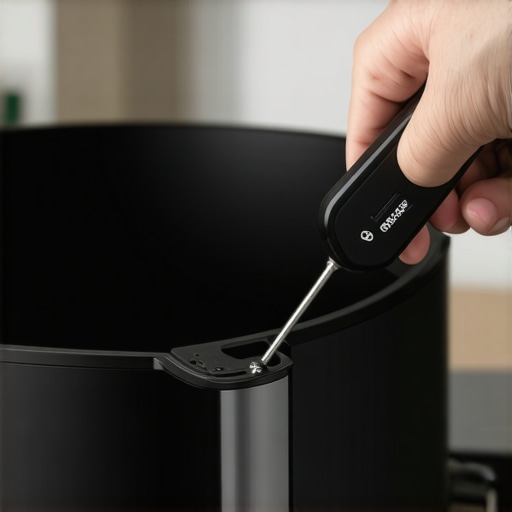
Opening your air fryer basket to check the temperature is a Catch-22: you need to see if it is hot enough, but every second the drawer is open, you are losing up to 25 degrees of heat. This is where the Thermapen ONE becomes an essential asset. While most digital thermometers take 3 to 5 seconds to stabilize, this tool provides a final reading in one second or less. According to the official ThermoWorks specifications, it boasts an accuracy of ±0.5°F, which is vital when you are trying to determine if your air fryer’s offset is consistently off by 10 degrees or just fluctuating wildly during its cycle.
- Full readings in 1 second or less for minimal heat loss
- Accuracy to ±0.5°F (±0.3°C) for precise calibration
- Motion-sensing sleep and wake mode for battery efficiency
- IP67 waterproof rating for easy kitchen cleanup
- Auto-rotating display for easy reading at any angle
In our testing, the Thermapen ONE felt like a surgical instrument rather than a kitchen gadget. We used it to spot-check the air temperature immediately after the cycle paused, and the results were eye-opening. The display is incredibly bright, so you aren’t craning your neck to see the numbers while steam is hitting your face. However, the price is a significant barrier for many. If you aren’t a frequent cook or a culinary nerd, spending roughly $100 on a thermometer might feel like overkill. But for those who have ruined expensive cuts of meat due to a faulty internal air fryer sensor, it is a one-time investment in culinary peace of mind.
The Pros & Cons of Speed
- ✅ Pro: Unmatched speed prevents significant heat loss during testing.
- ✅ Pro: Incredibly durable build quality and easy to sanitize.
- ⛔ Con: High price point compared to entry-level digital probes.
- ⛔ Con: No ‘leave-in’ capability; strictly for manual spot checks.
2. Rubbermaid Stainless Steel Oven Thermometer
Best for: Budget-conscious home cooks who want a “set it and forget it” verification tool.
If you don’t want to stand over your appliance with an expensive digital probe, you need something that lives inside the heat. The Rubbermaid Oven Thermometer is a low-tech hero. Unlike digital sensors that can be fried by extreme proximity to high-wattage heating elements, this analog dial is built to endure the harsh environment of a convection chamber. The frustration of “guessing” the dial position on a manual air fryer is instantly solved by hanging this on the side of the basket or resting it on the bottom rack while the unit runs.
- Large, easy-to-read 2-inch dial with Fahrenheit and Celsius
- Heavy-duty stainless steel construction for longevity
- Temperature range: 60°F to 580°F (15°C to 300°C)
- NSF certified for high-standard food safety
- Battery-free operation ensures it is always ready
We found that the real value here is monitoring the “preheat” phase. Many air fryers beep to signify they are ready long before the actual air temperature has stabilized. By watching the Rubbermaid dial through the viewing window, we discovered our mid-range test unit took an extra four minutes to reach the target 400°F after the chime sounded. The downside? If your air fryer doesn’t have a viewing window, you have to open the drawer to read it, which causes an immediate temperature drop. The dial can also be a bit sluggish to react compared to digital sensors, taking about 30 to 45 seconds to reach an accurate reading once placed in the heat.
Practical Reliability vs. Digital Speed
- ✅ Pro: Extremely affordable and requires zero maintenance or batteries.
- ✅ Pro: Can be left inside the air fryer throughout the entire cooking process.
- ⛔ Con: Hard to read through grease-stained or small viewing windows.
- ⛔ Con: Analog response time is significantly slower than digital alternatives.
3. Etekcity Lasergrip 1080 Infrared Thermometer
Best for: Mapping thermal hot spots and detecting heat leakage around the basket seals.
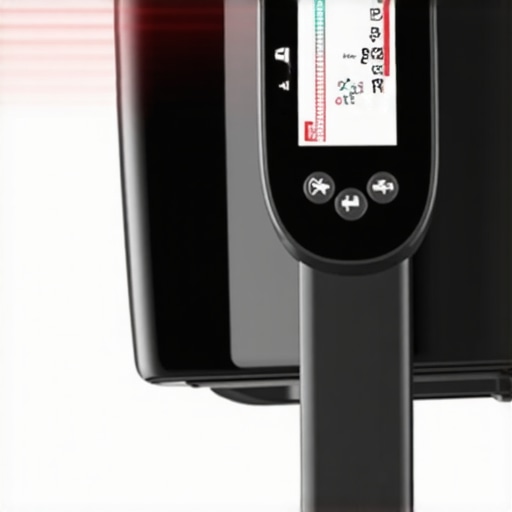
While traditional probes tell you the temperature of one specific point, the Etekcity Lasergrip 1080 allows you to map the entire interior of your air fryer. By scanning the walls and the heating element, you can identify if your unit has ‘dead zones’ where air isn’t circulating properly. This is particularly useful for larger 8-quart or dual-basket models where uneven heating is a common complaint. It’s also an excellent tool for troubleshooting why most air fryers dont reach the advertised temperature; by pointing the laser at the exterior seams, you can see if heat is escaping through a faulty gasket.
- 12:1 distance-to-spot ratio for safe measuring from a distance
- Wide temperature range from -58°F to 1022°F (-50°C to 550°C)
- Backlit LCD screen for high visibility in dim kitchens
- Instant results with a trigger-pull mechanism
- Adjustable emissivity for more accurate readings on shiny surfaces
During our diagnostic phase, the Etekcity revealed that our test unit was running 15 degrees cooler near the handle side than the back wall. This insight allows a cook to rotate the basket mid-cycle with more intent. However, you must remember that infrared thermometers measure surface temperature, not air temperature. To calibrate the air itself, you need to point it at a dark, matte-finished pan inside the fryer rather than the air. It is a specialized tool that provides a different layer of data than a standard meat probe.
Can an infrared laser actually measure the air temperature?
Technically, no. Infrared thermometers detect thermal radiation from surfaces. To get an accurate air reading with this tool, place a cast iron or dark ceramic plate inside the air fryer for five minutes, then measure the plate’s surface. This will give you a stable proxy for the ambient heat without the fluctuations caused by moving air currents.
Pros & Cons of Infrared Mapping
- ✅ Pro: Safely identifies dangerous external heat leaks on the appliance body.
- ✅ Pro: Perfect for finding uneven heating patterns in large baskets.
- ⛔ Con: Cannot measure ambient air temperature directly without a surface proxy.
- ⛔ Con: Shiny stainless steel interiors can cause inaccurate ‘ghost’ readings.
4. Polder Digital In-Oven Thermometer & Timer
Best for: Continuous monitoring of internal temperatures without opening the basket and losing heat.
If the Thermapen ONE is a sprint, the Polder Digital is a marathon. This tool features a thin, heat-resistant cable that connects the probe inside the air fryer to a display unit sitting on your counter. This solves the primary issue with air fryer calibration: the massive heat loss that occurs every time you open the drawer. By snaking the thin wire through the corner of the basket seal, you can watch the temperature rise, fall, and stabilize in real-time throughout the entire 20-minute cooking cycle. It provides a level of data logging that handheld units simply cannot match.
- 40-inch heat-resistant wire probe for flexible placement
- Programmable temperature alerts to notify you of target heat
- Wall-mountable or magnetic base for easy storage
- Large digital display with simultaneous clock and timer
- Temperature range: 32°F to 392°F (0°C to 200°C)
We found the Polder particularly effective for ‘offset calibration.’ By setting the air fryer to 375°F and watching the Polder display for ten minutes, we could see exactly how much the thermostat cycled. Our test unit didn’t stay at 375°F; it fluctuated between 360°F and 390°F. Knowing this average allows you to adjust your recipes for better results. The only downside is that the wire, though thin, can occasionally prevent a perfect seal on very tight-fitting baskets, causing a slight localized temperature drop. Check availability for the Polder Digital Thermometer.
Consistency Over the Long Haul
- ✅ Pro: Provides a ‘live feed’ of temperature changes without opening the fryer.
- ✅ Pro: Alarm feature is excellent for knowing exactly when preheating is finished.
- ⛔ Con: The wire probe is a failure point if it gets kinked or pinched too hard.
- ⛔ Con: Maximum temperature is capped at 392°F, which is slightly low for high-sear settings.
The Connoisseur’s Roadmap: Navigating the Luxury Kitchen Market
Stepping into the world of high-end kitchen appliances is often more overwhelming than it is exciting. The glitz of polished chrome and the allure of digital displays can easily distract from the core mission: culinary precision and longevity. Whether you are hunting for an espresso machine that rivals a Roman cafe or a stand mixer that will survive a decade of heavy doughs, the key is to look past the marketing and into the engineering.
Beyond the Chrome: The Science of Thermal Mass
When evaluating premium cookware or air fryers, ignore the aesthetic finish and ask about thermal mass. In the world of 5-ply copper core pans or heavy-duty air fryers, weight is your friend. Higher mass means the vessel retains heat more effectively when cold food is added, preventing the ‘temperature crash’ that leads to uneven cooking. A luxury espresso machine with a brass boiler will outperform a stainless steel counterpart because brass holds heat with far more stability during the extraction process. If a piece of equipment feels suspiciously light for its price tag, it is likely relying on branding rather than physics.
The Digital Trap: Why Your Appliances Don’t Need an App
The most common marketing gimmick in modern luxury kitchens is ‘smart’ connectivity. While a Wi-Fi-enabled air fryer or a touchscreen toaster sounds futuristic, these are often the first components to fail. In the industry, we call this a ‘point of failure injection.’ A high-end appliance should be a mechanical masterpiece, not a tablet with a heater attached. Look for physical switches, analog dials, or highly shielded electronics. If an appliance requires a firmware update to make toast, you aren’t buying a tool; you are buying a liability. True luxury is found in a machine that performs its primary function perfectly for twenty years, not one that sends a notification to your phone.
Torque Over Wattage: Decoding the Stand Mixer Myth
Manufacturers often use wattage as a proxy for power, but this is a deception. High wattage often indicates an inefficient AC motor that generates more heat than actual rotational force. When choosing a stand mixer, look for those with DC motors and all-metal gear construction. A 500-watt DC motor will often provide significantly more torque and run quieter than a 1000-watt AC motor found in entry-level ‘professional’ models. This is the difference between a mixer that struggles with bagel dough and one that kneads it effortlessly without the smell of burning ozone.
The ‘Serviceability’ Score: Buying a Tool for Life
The final hallmark of a true luxury kitchen investment is repairability. Premium brands like Vitamix, Jura, or All-Clad maintain their value because they offer replacement parts and authorized repair centers. Before you buy, check the manufacturer’s website for ‘user-replaceable parts.’ If a simple gasket leak in an espresso machine requires shipping the entire 50-pound unit across the country, it’s not a professional-grade tool. Investing in gear that is designed to be maintained rather than replaced is the ultimate way to ensure your kitchen remains a hub of high-performance cooking for the long haul.
Answers to Your Burning Culinary Questions
Why does my high-end espresso taste sour despite using premium beans? Sourness usually indicates under-extraction. You can learn more about why your espresso tastes sour, but the culprit is often too low a water temperature or a grind that is too coarse.
Is 5-ply cookware actually worth the investment for a home cook? For those searing at high heat, yes. However, for everyday tasks, some find that 5-ply cookware is total overkill compared to high-quality 3-ply alternatives.
Why is my air fryer producing excessive smoke? This is usually caused by grease splashing onto the heating element. Understanding the reason your air fryer smokes can help you prevent messy kitchen mishaps.
My stand mixer smells like it’s burning when I make bread. Is it broken? Not necessarily. It often happens when the motor is strained. Check out why your stand mixer smells like its burning to see if you need to adjust your batch size or speed.
Which Calibration Tool Should You Choose?
Selecting the right diagnostic tool depends entirely on your cooking style and how much data you crave. If you want the absolute best performance and laboratory-grade speed, get the Thermapen ONE. Its one-second reading is unmatched for preventing heat loss during the calibration process. If you are on a budget but want reliable verification, stick with the Rubbermaid Stainless Steel Oven Thermometer. It is a low-cost, set-it-and-forget-it tool that won’t let you down. If you need to monitor temperature fluctuations over a long period without ever opening the basket, the Polder Digital In-Oven Thermometer is the winner for continuous data.
Mastering how to calibrate the temperature on a high end air fryer is the first step toward professional-level results. Whether you are upgrading to premium cookware or perfecting your morning brew with elite espresso machines, precision is the true mark of a luxury kitchen. Don’t let a drifting thermostat ruin your culinary creations—take control of your heat today.