
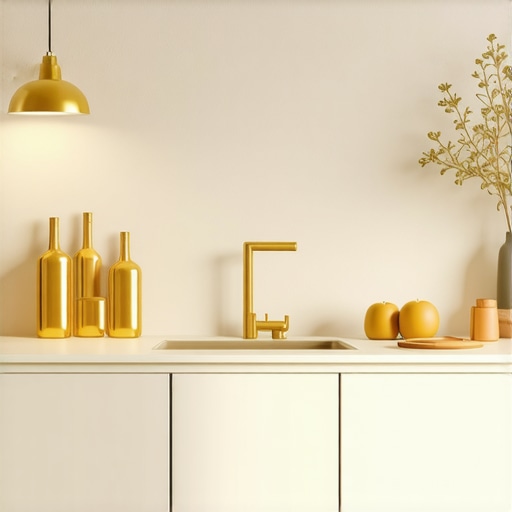
The Best Lighting Temperature for a Gold-Accented Kitchen
Gold accents in a high-end culinary space represent a significant investment in aesthetic capital. Whether it is a brushed brass faucet or custom champagne-gold hardware, the material choice is only half the battle. The other half is physics. After fifteen years of designing and technical consulting for luxury kitchen environments, I have observed a recurring failure: homeowners selecting lighting based on ‘vibes’ rather than spectral power distribution. If you get the Kelvin rating wrong, your premium gold fixtures will look like tarnished tin or, worse, a muddy brown mass. The stake here is visual integrity. Getting this wrong destroys the perceived value of your cabinetry and premium cookware. My stance? Neutrality is a myth. You are either enhancing the metallic bond or you are suppressing it.
The Engineering of Reflection
Gold is a selective reflector. It absorbs shorter wavelengths—the blues and greens—and reflects the longer ones—the yellows and reds. To make gold ‘pop’ without veering into an artificial orange glow, you need to understand the Kelvin scale. The industry standard often suggests 2700K for residential warmth, but for gold, this is a trap. It oversaturates the metal, making it look dated and heavy. Conversely, 4000K or 5000K bulbs, often marketed as ‘daylight,’ introduce too much blue light. This blue light clashes with the gold’s natural reflectivity, creating a visual ‘clash’ that makes the surface look cheap. The technical sweet spot is 3000K. This temperature provides enough blue-spectrum energy to keep the space feeling modern while providing the warm-spectrum energy required to activate the gold’s luster. Beyond Kelvins, you must look at the Color Rendering Index (CRI). A CRI below 90 is unacceptable in a luxury kitchen. Specifically, look for the R9 value, which dictates how red and warm tones are rendered. Without a high R9, your gold will look hollow.
The Specular Stress Test
I recall a project in a penthouse where the client insisted on ultra-cool 4500K recessed lighting. They had installed top-tier espresso machines with gold-plated dials and a custom hood. The result? A clinical, cold atmosphere where the gold looked like stainless steel with a grease film. We had to perform a full spectral correction. We replaced the drivers and move to a high-output 3000K system with dimmable controls. The lesson was clear: specular reflection (the mirror-like glint off polished metal) requires a balanced light source. If the light source is too diffuse or too blue, the glint loses its warmth. This also affects how your pot filler above the range appears against the backsplash. Light temperature isn’t just about the ceiling; it is about the interaction with every vertical surface. Poor lighting leads to harsh shadows that can make even a high-end countertop look uneven.
[IMAGE_PLACEHOLDER]
Strategic Foresight for 2025
The industry is moving toward ‘Tunable White’ technology. In the next 12 to 24 months, static Kelvin ratings will become obsolete in the luxury sector. Smart systems will allow users to shift from 2700K in the evening for dining to 3500K during food prep. This shift is driven by the Illuminating Engineering Society (IES) standards regarding circadian-effective lighting. If you are renovating now, do not lock yourself into a single temperature. Ensure your LED drivers are compatible with digital multiplex (DMX) or similar control protocols. This allows you to adjust the ‘warmth’ of your gold accents as the natural light in the room changes throughout the day. This is the difference between a static room and a dynamic environment. It also prevents the common issue where island lighting feels harsh at night. Regulatory changes are also pushing for higher efficacy (lumens per watt), but be careful—many high-efficacy bulbs sacrifice CRI. Always demand the photometric report from the manufacturer.
The Executive Verdict
My recommendation is a strict ‘Hold’ on any lighting purchase until you have tested a sample bulb against your specific gold finish. Metals vary by manufacturer; a ‘Satin Bronze’ from one brand reflects differently than a ‘French Gold’ from another. If you are in a high-stakes renovation, install a 3000K system with a CRI of 93 or higher. This is the only way to ensure your high-end faucet and hardware maintain their intended color profile. Avoid ‘smart bulbs’ that rely on cheap RGB chips; they lack the phosphor quality needed for accurate metal rendering. Stick to dedicated LED fixtures with COB (Chip on Board) technology for the best thermal management and light density. Is 3000K the best for a gold-accented kitchen? Yes, provided the CRI is high enough. Does it wash out other colors? No, it actually provides a balanced spectrum for food prep and social interaction. How do I avoid glare on gold? Use recessed lights with a deep regressed trim to hide the light source. Why does my gold look green? You likely have bulbs with a low CRI or a green-tinted ‘daylight’ bulb; swap them for 3000K high-R9 LEDs immediately.