
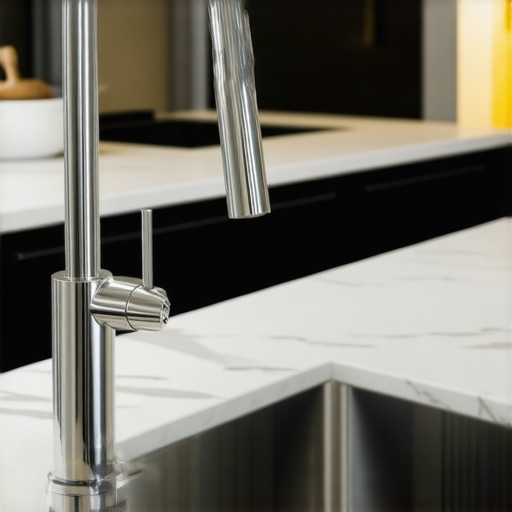
How to Fix a Wobbly Faucet in a High-End Kitchen
A loose kitchen faucet is more than a minor irritant in a luxury residence; it is a structural failure waiting to happen. When a professional-grade fixture begins to sway, the stress is transferred directly to the mounting hardware and the stone substrate. Ignoring this instability eventually leads to seal degradation and sub-cabinet water damage. After fifteen years in high-end kitchen installations, I have seen five-thousand-dollar faucets rendered useless by a simple failure in torque management. The core problem is usually a loosening of the mounting nut on the faucet shank, often exacerbated by the vibration of high-pressure sprayers or the sheer weight of solid brass components. You aren’t just tightening a nut; you are recalibrating the interface between mechanical plumbing and architectural stone.
Fixing it early prevents the same frustration as a drawer that won’t stay closed in your custom cabinetry. The mechanical integrity of your kitchen relies on every moving part remaining anchored. In the context of luxury hardware, we often deal with thicker-than-standard granite or quartzite slabs. This requires extended shanks and specialized mounting kits that many general contractors overlook during the initial build. If your faucet moves when you toggle the handle, the tension on the supply lines is also shifting. This creates a risk of fatigue failure at the compression fittings. It is an engineering reality that requires immediate intervention.
The Engineering Reality of High-Torque Fixtures
The stability of a premium faucet relies on the friction between the mounting washer and the underside of the countertop. In high-end kitchens, we frequently see massive bridge faucets or industrial-style pull-down sprayers. These units exert significant leverage on the base. When you pull that sprayer head, you are applying a torque load to the mounting assembly. If the mounting nut was not secured with a thread-locking compound or a specialized friction washer, it will back off over time. The physics are simple. Repeated motion equals vibration. Vibration equals loosening.
Technical truth: Most luxury faucets come with a ‘C-shaped’ mounting plate. This design allows for installation without removing the entire valve assembly, but it is prone to slipping if the stone surface is uneven or if the plumber used a plastic nut in a high-torque application. We only use brass mounting nuts in our projects. The weight of the industrial grade steel and the density of the brass provide a thermal stability that cheaper alloys lack. This stability is particularly vital for a pot filler above the range where structural integrity is non-negotiable. You need to verify that the shank is centered in the hole; otherwise, the pressure is unevenly distributed across the countertop edge.
The Practical Fix Protocol
To begin, clear the area under the sink. You cannot perform precision work while dodging water filters and cleaning supplies. You will need a basin wrench—the telescopic variety is best for deep-set luxury sinks—or a dedicated faucet tool provided by the manufacturer. Reach up and feel the mounting nut. If it turns by hand, you have found the culprit. However, simply tightening it with your fingers is a temporary fix. You must achieve a specific torque to ensure the gasket is compressed sufficiently to prevent future movement. The ergonomic layout is often dictated by the countertop depth secret, but even the best stone can’t hold a loose faucet if the hardware is substandard.
If you ignore it, the sound of water vibration might mimic why your luxury fridge is making a loud clicking noise as the pipes knock against the cabinetry. The process involves three steps. First, verify the gasket position. If the rubber seal has slipped out from under the faucet base, the unit will never be stable. Second, apply a small amount of removable thread-locker to the shank threads. Third, tighten the nut until the base is immovable, but do not exceed the threshold where you might crack the stone. Quartzite, while hard, can be brittle under localized point-loading.
Operational Risks and Material Failure
The messy reality? Sometimes the hardware itself has failed. I remember a project in a penthouse where the ‘luxury’ faucet used a zinc-alloy mounting plate that had corroded due to a slow, undetected leak. The clank of the manifold hitting the floor when the metal finally snapped was a sound I won’t forget. The smell of oxidized brass and damp cabinet liners told the story of months of neglect. If you find that the nut spins but does not tighten, the threads on the shank are stripped. This is a catastrophic failure that usually requires a total fixture replacement.
According to standards set by the International Association of Plumbing and Mechanical Officials (IAPMO), all fixtures must be installed in a manner that prevents movement that could stress the supply lines. Movement in the faucet body transfers that energy directly to the PEX or copper lines below. Over time, this leads to a pinhole leak at the connection point. The cost of a new faucet is negligible compared to the cost of replacing water-damaged custom walnut cabinetry. This is why we advocate for biannual inspections of all high-end kitchen hardware.
Market Trends and Strategic Foresight
Looking at the next 18 months, we are seeing a shift toward ‘no-touch’ and voice-activated faucets in the luxury sector. These units are significantly more complex because they include solenoids and battery packs mounted under the sink. This added weight and bulk make the initial stability even more critical. A wobbly touchless faucet will eventually cause the sensors to misfire as the internal wiring is pinched or pulled. The plumbing industry is also moving toward stricter lead-free regulations, as outlined by the American Society of Mechanical Engineers (ASME), which means the alloys used in modern faucets are harder and more prone to snapping if over-torqued.
The result? Avoidable failure. If you are planning a renovation, ensure your stone fabricator cuts the faucet hole to the exact millimeter specified by the manufacturer. A hole that is even 3mm too large significantly reduces the surface area available for the mounting nut to grab, leading to perpetual wobbling regardless of how much you tighten it. Precision at the fabrication stage is the only way to guarantee a lifetime of stability.
The Executive Verdict
If your faucet is wobbling, do not wait. Check the mounting nut today. If the nut is metal and the threads are clean, tighten it with a basin wrench and a drop of thread-locker. If the hardware is plastic or showing signs of corrosion, replace the mounting kit immediately. For those in a situation where the stone hole is oversized, use a oversized stainless steel ‘fender washer’ on the underside to distribute the load. Stop the movement before it becomes a flood.
Frequent Questions Regarding Luxury Faucets
Can I use plumber’s putty to stop the wobble?
No. Plumber’s putty is a sealant, not a structural adhesive. It will not stop a heavy faucet from moving and can actually stain certain types of natural stone like marble.
Why does my faucet keep coming loose every few months?
This is usually due to the lack of a friction washer or the use of a smooth plastic mounting nut. Vibration from the pull-down hose retracting eventually backs the nut off the threads.
Do I need to shut off the water to tighten the mounting nut?
Technically no, but it is a wise precaution. If a supply line is already stressed, the act of tightening the faucet could be the final straw that causes a leak.
Is a basin wrench necessary for this fix?
In a high-end kitchen with deep sinks and tight clearances, a standard wrench will not reach the nut. A telescopic basin wrench is the industry standard for this task.
How tight is too tight when working with stone?
Tighten until the unit is firm and does not move when the handle is operated vigorously. Do not use power tools; hand-tightening with a wrench is sufficient to avoid cracking the stone.