
The Hidden Air Fryer Filter You Forgot to Clean
Most luxury kitchen owners operate under a dangerous delusion. They believe that because they scrub the non-stick basket and wipe the exterior, their air fryer is pristine. It is not. After fifteen years in the high-end appliance industry, I have seen more $500 units fail due to neglect of a component that isn’t even mentioned in the basic manual: the internal intake and exhaust mesh. This is not just about hygiene. It is about engineering. When aerosolized fats bypass the basket, they do not simply vanish. They coat the internal fan blades and the micron-thin filters designed to protect the motor from thermal overload. If you ignore this, you are not just making mediocre food; you are operating a fire hazard.
The issue is simple physics. High-speed convection relies on a specific Cubic Feet per Minute (CFM) of airflow. As lipids vaporize during a high-heat cycle, they become airborne. The air intake, usually located at the top or rear of the device, pulls these grease-laden molecules directly through the electrical housing. Most premium models, including those from luxury kitchen brands, utilize a secondary mesh or a carbon-impregnated foam filter to catch these particles. Over six months, this filter becomes a solid wall of carbonized sludge. The result? Total mechanical failure. This lack of maintenance is frequently why your air fryer takes longer to cook than the recipe says because the heat can no longer circulate at the required velocity.
The Mechanics of Grease Migration
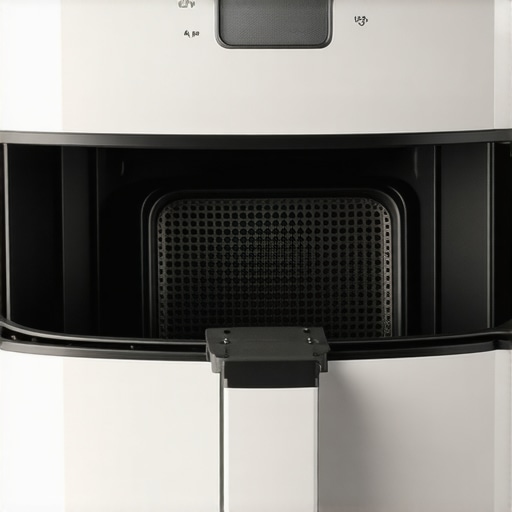
To understand the risk, you must understand the fluid dynamics inside the chamber. When the fan spins at 2,500 RPM, it creates a vortex. This vortex is intended to strip moisture from the surface of the food. However, it also pulls fine droplets of oil upward. In many designs, a metal screen sits between the heating element and the fan. This screen is your first ‘hidden’ filter. When this screen clogs, the heating element begins to radiate heat back into the electronics instead of into the food. This creates a feedback loop of thermal stress. I have stood in luxury kitchens where the smell of fresh adhesive and scorched wire was the only warning before a board fried.
When this airflow is restricted, you might notice the reason your air fryer fan makes a high-pitched squeal is almost always a grease imbalance on the impeller blades. The fan becomes ‘heavy.’ It wobbles. It grinds. Eventually, the thermal fuse blows. According to reports from the National Fire Protection Association, kitchen appliances are leading causes of residential fires, and poorly maintained convection systems are a significant subset of that data. You must treat your air fryer like a miniature HVAC system, not a frying pan.
The Reality of Maintenance Failure
I recall a specific client in a high-rise penthouse. They owned a top-of-the-line stainless steel air fryer that had stopped ‘crisping.’ The exterior was spotless. The basket was gleaming. But when I pulled the rear access panel, the intake filter was so saturated with old canola oil that it had the consistency of cold honey. The unit was drawing zero fresh air. It was essentially a slow oven masquerading as a high-speed circulator. We had to perform a full technical strip-down. To prevent this, owners must realize that why most air fryer liners are a waste of money is because they actually force more grease upward into the motor housing by blocking the downward airflow paths. Use the rack, let the air move, and clean the intake.
Future Standards in Luxury Kitchen Tech
The industry is shifting. In the next 18 months, I expect to see the Association of Home Appliance Manufacturers push for stricter ‘easy-access’ mandates for internal filters. We are moving toward HEPA-integrated systems for air fryers to mitigate the PM2.5 particles released into luxury homes. Until then, you are the technician. You must manually inspect the upper chamber every thirty cycles. For the heating element itself, the best way to clean greasy air fryer coils without chemicals is a steam-based approach while the unit is disconnected. This prevents the carbonization of the filter mesh before it becomes a permanent blockage.
Final Directives
My verdict is firm: treat your air fryer with the same technical respect you give your espresso machine or your range hood. If you are a heavy user—cooking more than four times a week—you must perform a deep clean of the intake ports monthly. If you smell even a hint of smoke when the unit is ‘clean,’ your hidden filter is already compromised. Do not wait for the motor to seize. Unplug the unit, check the exhaust baffles, and clear the mesh. Your appliance will last five years instead of fifteen months.
Frequently Asked Questions
Where exactly is this hidden filter located? It is usually found behind a plastic or metal grate at the top of the cooking chamber or at the air intake on the rear. Check your specific model’s exploded view diagram online if it is not visible.
Can I wash the filter in the dishwasher? Only if it is a stainless steel mesh. If it is a carbon or foam filter, it must be replaced. Dishwashing a carbon filter will destroy its odor-neutralizing properties and likely clog your dishwasher with oily residue.
How do I know if my filter is clogged without opening the unit? Place your hand near the exhaust vent during a cycle (carefully). If the air feels weak or exceptionally hot compared to when the unit was new, your airflow is restricted. A healthy unit should have a forceful, consistent blast of warm air.