
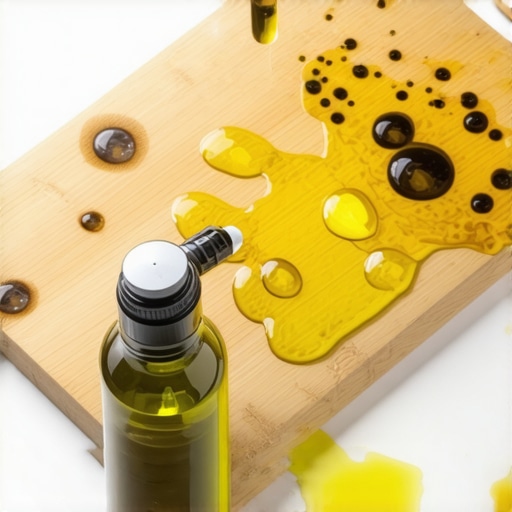
The Cutting Board Oil Mistake That Leads to Mold
A four-hundred-dollar walnut end-grain board is a biological liability if you treat it with kitchen pantry oils. After fifteen years managing luxury kitchen inventories and testing the limits of high-end wood surfaces, I have witnessed the same catastrophic failure hundreds of times. The mistake? Thinking food-grade means food-safe for maintenance. When you apply olive, vegetable, or canola oil to a porous wood surface, you aren’t protecting it. You are feeding a future fungal colony. These organic fats oxidize and go rancid within the wood fibers. The result? Avoidable failure. This isn’t just about a bad smell; it is about the structural integrity of your board and the hygiene of your prep surface. If you are serious about your equipment, especially if you understand why you should never put your high-end chef knife in the dishwasher, you need to grasp the chemistry of wood saturation.
The Molecular Mechanics of Lipid Oxidation
Wood is a hygroscopic material. It breathes, expanding and contracting based on ambient humidity and moisture contact. To stabilize a board, we use oil to occupy the cellular voids. However, culinary oils consist of long-chain fatty acids that are highly unstable when exposed to oxygen. Once these oils penetrate the grain, they begin a process of lipid oxidation. They turn sticky. They attract dust. Most importantly, they provide a nutrient-rich environment for mold spores to take root deep within the wood’s vascular system. Unlike food-grade mineral oil, which is a non-reactive, stable alkane, vegetable oils decompose. This decomposition creates a pungent, sour odor that is nearly impossible to extract once it has permeated the core of an end-grain block. You shouldn’t treat a premium board with the same casualness as why your non-stick pan is peeling after only three months; wood requires a chemically inert barrier. For a technical standard on food contact substances, the FDA Food Contact Substance guidelines clarify the necessity of using non-oxidizing agents.
The Financial Risk of Structural Warping
Ignoring proper maintenance isn’t just a sanitation issue. It is a financial sinkhole. When mold takes hold, it often stays hidden beneath the surface until the wood begins to delaminate. The glue joints in high-end edge-grain or end-grain boards are tested by the expansion of mold-heavy fibers. I have seen heirloom-quality boards split down the center because the owner thought ‘natural’ oils were better. The economics don’t track. You spend thousands on a the countertop material that actually withstands heat, yet allow a $50 maintenance error to ruin the centerpiece of your prep station. The cost of a 16oz bottle of pure USP-grade mineral oil is negligible compared to the replacement cost of a bespoke Boos block. Precision matters here, much like why every serious home cook needs a digital scale for consistency.
The Sensory Reality of a Failed Board
Close your eyes and imagine the scent of a professional kitchen. It should be clean, sharp, and metallic. Now, imagine a damp, sour, musty undertone that lingers on every slice of bread or piece of fruit. That is the smell of rancid olive oil trapped in oak. Feel the surface. It shouldn’t be tacky or gummed up. A properly maintained board feels smooth, cool, and slightly waxy. If your board feels like it has a film of old scotch tape on it, the oxidation has already begun. I recall a client in a high-humidity coastal market who insisted on using flaxseed oil. Within six months, the board was a grey, fuzzy mess of mycelial growth. We had to plane off a full quarter-inch of wood just to find a clean, non-infected layer. It was a surgical recovery for a preventable wound.
The Strategic Evolution of Kitchen Woodwork
Looking at the 2025 market, we are seeing a shift toward denser, exotic hardwoods like teak and acacia. These woods have higher natural oil content, but they are not immune to the pantry oil trap. In fact, their density makes the removal of rancid oils even harder. Regulatory bodies are tightening the screws on ‘organic’ marketing, pushing consumers back toward proven, stable synthetics for food safety. The smart money is moving toward beeswax and mineral oil blends—substances that provide a hydrophobic seal without the risk of biological decay. We expect to see more boards sold with integrated ‘maintenance sensors’ or simple color-change indicators that flag when the wood’s moisture level drops below the safety threshold.
The Executive Verdict on Maintenance
Hold your pantry oils for the pan. For your wood, only USP-grade mineral oil or a high-viscosity butcher block conditioner is acceptable. If your board is currently sticky or smelling off, stop using it immediately. Sand it down, sanitize with a diluted vinegar solution, and restart with a stable, non-reactive oil. My recommendation: if you have a board worth more than $100, oil it once a month without fail. Do not wait for it to look dry. Prevention is the only viable strategy in high-end culinary management.
Frequently Asked Questions
Can I use coconut oil instead? No. While coconut oil has a longer shelf life, it still contains fats that can go rancid. Only ‘fractionated’ coconut oil is stable enough, but even then, mineral oil is the superior, more cost-effective standard.
How do I know if mold is already inside the wood? Look for dark spotting or ‘spalting’ that doesn’t scrub off. If the wood has a greyish tint despite being dry, fungal growth has likely started within the grain.
Is mineral oil safe to ingest? USP-grade mineral oil is a food-grade laxative and is completely safe for food-contact surfaces according to the USDA standards for food prep equipment.
How often should I deep-clean the board? Every 3-4 months, use a coarse salt and lemon scrub to pull out surface impurities before a heavy re-oiling session.