
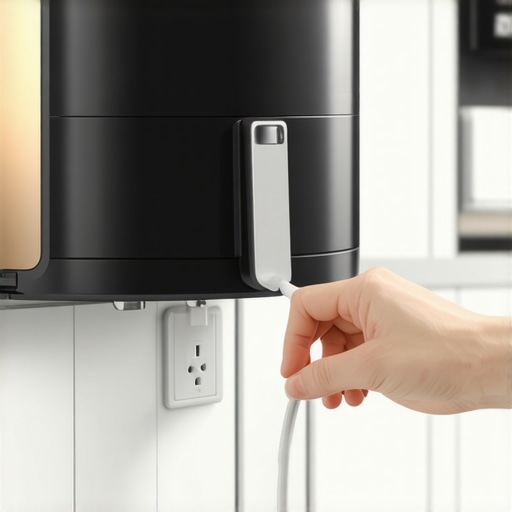
How to Stop Your Air Fryer from Blowing a Fuse
Your high-end air fryer is effectively a redirected industrial heat gun. Most premium models pull between 1,500 and 1,800 watts during the initial heating phase. In a standard American kitchen, this creates an immediate conflict with the existing electrical infrastructure. I have spent two decades diagnosing why luxury appliances fail in real-world environments. The diagnosis is rarely a defective unit. It is almost always a failure of electrical load management. If your breaker snaps the moment you hit the ‘Air Fry’ button, you are witnessing physics overriding poor planning. The result? Avoidable failure.
Understanding the amperage math is the only way to solve this. A standard 15-amp circuit can technically handle 1,800 watts, but the National Electrical Code (NEC) recommends a 20% safety margin for continuous loads. This means you should really only pull 1,440 watts on a 15-amp line. When you plug in one of the top models that redefine healthy cooking in 2025, you are often redlining that circuit. If a refrigerator compressor kicks on or a few dimmable under-cabinet lights are active on the same run, the thermal trip curve of the breaker is breached. It is a binary reality: the copper cannot handle the heat, so the spring-loaded switch kills the connection.
The Engineering Reality
The heating element in an air fryer is a resistive load. Unlike the inductive load found in the high wattage stand mixer motors used for heavy dough, the air fryer demands its full current immediately. This inrush of power causes a momentary spike. If the breaker is already stressed by an aging espresso machine or a microwave, the circuit dies. We often see homeowners try to reset the breaker repeatedly. This is a dangerous gamble. Every trip weakens the internal mechanism of the breaker, making it more prone to ‘nuisance tripping’ later. According to the National Fire Protection Association (NFPA), electrical distribution equipment is a leading cause of home fires. Ignoring a blowing fuse is ignoring a thermal warning.
Why Standard Methods Fail
Most people try using a different outlet. In many kitchens, multiple outlets are daisy-chained on a single 15-amp circuit. Moving the plug three feet to the left accomplishes nothing if the wire returns to the same breaker. The smell of ozone or warm plastic near an outlet is a sign of high resistance. This happens when the tension in the outlet’s internal brass contacts has failed. Cheap outlets cannot handle the sustained 12.5-amp draw of a luxury air fryer. You need commercial-grade receptacles. I have seen $200 air fryers melt $0.50 outlets because the owner didn’t understand the demand of 12-gauge vs. 14-gauge wiring.
Strategic Load Balancing
If you cannot rewire the kitchen today, you must adopt a sequential operation strategy. Your espresso machine takes forever to heat up because of its own massive thermal blocks; running it simultaneously with an air fryer is a guaranteed trip. Map your kitchen. Identify which outlets sit on which breakers by turning them off one by one. Label them. It sounds archaic, but it is the only way to ensure your air fryer has the ‘clean’ air it needs to function without starving other appliances of voltage. Low voltage doesn’t just blow fuses; it can burn out the digital controllers on your premium cookware.
Market Corrections Ahead
The industry is moving toward 20-amp dedicated circuits as a baseline for any ‘appliance garage’ or luxury kitchen island. Within the next 18 months, I expect more local building codes to mandate dedicated lines for high-wattage countertop appliances. The era of the ‘general purpose’ kitchen circuit is ending. Second-order effects include higher resale values for homes with documented electrical upgrades. If you are renovating, do not settle for 15-amp lines. Demand 12-gauge wire and 20-amp breakers for every major countertop station.
Executive Verdict
If your air fryer is blowing fuses, stop using it on that circuit immediately. My recommendation is a ‘Buy’ on a dedicated 20-amp electrical run for your primary cooking zone. If you are a renter, your only safe strategy is ‘Sequential Usage’—unplugging all other devices on that circuit before starting a cook cycle. Do not use extension cords. Most are 16-gauge and will overheat, creating a fire hazard. The engineering fix is always better than the temporary workaround.
Common Electrical Queries
Can I just swap a 15-amp breaker for a 20-amp breaker? No. This is a fire hazard. The wire behind the wall (likely 14-gauge) is not rated for 20 amps and will melt before the breaker trips. Why does the fuse blow only after 10 minutes? Heat builds up over time. As the wire and breaker warm up, resistance increases, eventually crossing the trip threshold. Are certain air fryer brands more prone to this? Any brand pulling 1500W+ will have the same effect; it is a matter of wattage, not brand quality. Will a surge protector help? No. Surge protectors are for voltage spikes, not amperage overloads. They will likely trip their own internal fuse even faster.