
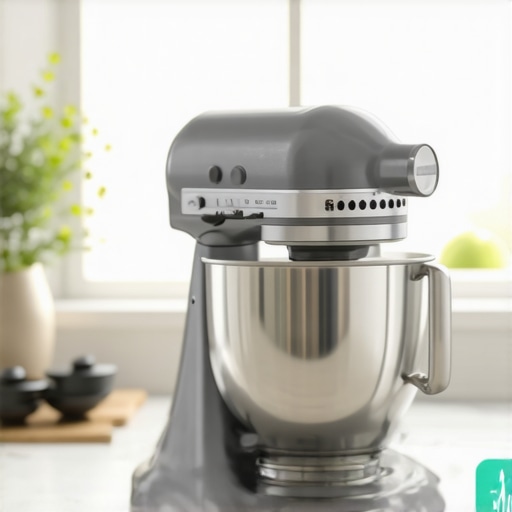
Why Your High-End Stand Mixer Is Whining at Low Speeds
The high-pitched acoustic signature emanating from your luxury stand mixer at speed settings one or two is rarely a sign of imminent mechanical collapse. Instead, it is the audible manifestation of modern motor control engineering. After 15 years diagnosing failures in premium culinary equipment, I can tell you that the sound you hear is likely the Pulse Width Modulation (PWM) frequency interacting with the motor’s copper windings. This isn’t a defect. It is the cost of precision torque. If you demand a machine that can handle 100% hydration sourdough without stalling, you accept the electronic ‘singing’ of the DC controller. High-end stand mixers, much like professional espresso machines, utilize sophisticated electronics to maintain constant RPM regardless of the resistance provided by the dough. The whine is the electronics working to keep your motor from burning out under the strain of heavy loads.
The Physics of Low Speed Torque
In the world of professional kitchen engineering, there is a constant battle between speed and power. Most consumer-grade mixers use AC motors with simple phase-control speed regulators. These are quiet, but they lose torque as you slow them down. When you hit a thick patch of dough, the motor bogs down. Luxury models, however, frequently employ DC motors or high-efficiency AC motors with advanced controllers. These controllers chop the electricity into thousands of tiny pulses per second to regulate speed without losing the ability to push through dense mixtures. This high-frequency switching creates vibration. Vibration creates sound. That is the whine. Understanding the heavy duty gear secret within these units helps explain why the noise persists; metal gears conduct these ultrasonic vibrations much more efficiently than plastic ones. The noise is a byproduct of industrial-grade durability. A plastic-geared machine might be quieter today, but it will be in a landfill within three years of heavy use.
Grease Migration and the Scent of Ozone
Mechanical reality is messy. Inside that die-cast housing, a planetary gear system is bathed in food-grade grease. Over time, heat causes this lubricant to thin and migrate. If your mixer’s whine has shifted from a digital hum to a mechanical ‘grind’ or ‘click,’ the grease has likely separated. This is an operational risk that many owners ignore until the gear teeth shear off. You might notice a faint smell of hot oil or ozone—a sharp, electric scent. This indicates the motor is drawing excessive current to overcome internal friction. This is the moment for intervention. It is a technical truth that most luxury appliance brands use a specialized NLGI 2 rated grease designed for high-temperature stability, yet even this fails if the machine is stored in a hot pantry or used continuously for 40-minute kneading sessions. Ignoring the change in pitch leads to a total gear reset. You can prevent this by following the the bread kneading speed that actually saves your motor, which usually means never exceeding speed two for heavy yeast doughs. The friction load at higher speeds generates heat that effectively ‘cooks’ the internal lubricants.
The Stress Test of Real World Baking
I recall a client in a high-humidity coastal environment whose professional-grade mixer started screaming during the holiday season. The culprit wasn’t the electronics. It was thermal expansion in the gear housing. The tolerances were so tight that as the metal heated, the gears began to bind. This is the ‘Stress Test’ of high-end engineering. What looks perfect on a CAD drawing in a climate-controlled lab fails when subjected to the reality of a 90-degree kitchen. When gears bind, the motor whines louder as it fights to turn. The result? Avoidable failure. If you feel the top of the mixer head and it is too hot to touch comfortably, stop. The machine is telling you its thermal limits have been reached. This is particularly relevant for those who have moved away from traditional methods to use air fryers and other high-tech gadgets, expecting every appliance to run indefinitely. Every motor has a duty cycle. Pushing past it turns a $1,000 investment into a paperweight. Regular maintenance, specifically knowing how to deep clean your stand mixers internal gears, is the only way to ensure the whining doesn’t turn into a terminal groan.
Strategic Foresight for the Kitchen Industry
The next 24 months will see a shift toward brushless DC (BLDC) motors in the premium segment. These motors eliminate the carbon brushes that cause friction and noise, potentially silencing the whine that plagues current top-tier models. We are also seeing a move toward integrated sensors that monitor gear temperature and lubricant viscosity in real-time. This follows the trend in high-end automotive engineering. Regulatory changes regarding energy efficiency in the EU and North America are forcing manufacturers to move away from inefficient universal motors toward these more complex, albeit noisier, electronic systems. The consumer must decide: do you want the silence of a weak machine, or the ‘song’ of a powerful one? My executive verdict is to ‘Hold’ on your current high-end gear. Do not replace a whining mixer unless the pitch changes or you see physical leaking. The current crop of machines is still more durable than the early-stage ‘smart’ mixers entering the market. If you are a high-volume baker, the noise is your assurance of torque. If the whisk isn’t hitting the bowl correctly, check why your stand mixer whisk doesn’t reach the bottom before assuming the motor is at fault. Precision requires calibration.
Essential FAQs
Is the whine a sign of a motor burning out?
Not usually. A burning motor produces a distinct, acrid smell and the pitch will fluctuate wildly. A steady, consistent whine is usually electronic frequency noise from the DC controller.
Should I oil my stand mixer gears?
Never use standard oil. These machines require specific food-grade grease with high tackiness. Using the wrong lubricant will cause it to leak into your food or fly out of the gear housing during operation.
Why is my mixer louder when kneading bread?
The motor is under high load, which increases the current draw. This makes the electronic switching frequency more audible as the controller works harder to maintain the planetary rotation speed.
Can I reduce the noise myself?
Placing the mixer on a heavy, solid wood or stone countertop can help dampen the vibrations. Avoid hollow cabinets or metal prep tables, which act as resonators for the high-pitched frequencies.