
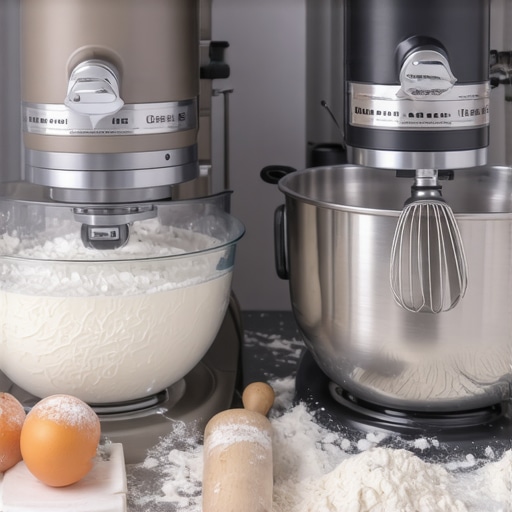
How to Choose a Stand Mixer for Bread vs. Cake Baking
The marketing brochures want you to look at the tilt-head mechanism and the glossy finish. They ignore the gear ratio. If you are serious about sourdough, that $300 department store special is a paperweight in training. After running this company for 15 years, I have seen hundreds of motors burned out by users who tried to treat a cake mixer like a construction-grade dough kneader. The stake is simple: buy for the wrong task, and you will be replacing the unit before the warranty expires. Bread and cake represent two ends of a mechanical spectrum. One requires brute force and low-speed endurance. The other demands high-speed aeration and delicate integration. Understanding the heavy-duty gear secret inside premium stand mixers is the first step in avoiding an expensive paperweight.
The Engineering Reality of Torque vs Speed
Bread dough is a non-Newtonian fluid that resists movement. To develop gluten, the machine must push through heavy resistance at a slow, steady pace. This requires torque. Most consumer-grade mixers use AC motors that rely on high RPMs to generate power and cool themselves. When you slow them down to knead, they lose their cooling capacity and the heat builds up in the housing. Professional-grade machines often utilize DC motors. These are superior because they provide maximum torque at the lowest speeds without overheating. For cakes, the requirement shifts. You need the whisk to move fast enough to trap air in egg whites or creamed butter. High speed is the priority here. If you use a high-torque bread machine for a delicate sponge, you might find the lowest speed is still too aggressive. The cost-benefit matrix is clear. A DC motor machine costs more upfront but survives 20 years of weekly bread. An AC motor machine is cheaper and excels at meringues but will fail under the weight of a heavy rye loaf.
Mechanical Failures and Operational Risks
What breaks first? Usually the sacrificial gear. Many modern brands use a single nylon gear inside an all-metal gearbox. The theory is that the nylon gear will strip if the motor is overloaded, protecting the expensive motor. In practice, the real reason your sourdough keeps breaking your mixer gears is often a combination of too much flour and too high a speed setting. I have stood in kitchens where the smell of ozone and burning brushes filled the air because a baker tried to knead a double batch of bagels. The machine walks across the counter. The head bounces. These are sensory warnings. If you see the tilt-head hinge jumping, the locking pin is being sheared. Another common issue is lubrication migration. Under high heat, the food-grade grease inside the head thins out. This is how to stop your stand mixer from leaking gray oil into the bowl: stop overloading the motor. The friction from bread dough is what causes that heat.
Market Corrections and Future Tech
The industry is moving toward smart sensors. Within 24 months, expect more machines with integrated scales and watt-meters that automatically shut down before the gears strip. Regulatory changes in energy consumption are forcing manufacturers to move away from inefficient high-wattage AC motors toward more efficient, permanent magnet DC motors. This is good for the baker. It means more power with less noise. We are also seeing a shift in bowl geometry. Narrower, deeper bowls are becoming the standard because they handle small batches of egg whites better while still providing enough surface area for dough expansion. According to the Association of Home Appliance Manufacturers (AHAM), consumer demand for professional-grade durability in home kitchens has spiked by 40% since 2020. This shift is forcing brands to reconsider plastic components in their mid-range lines. For the local buyer, this means the gap between a ‘pro’ model and a ‘hobbyist’ model is narrowing, but the price floor is rising.
The Executive Verdict
If your weekly routine involves heavy whole-grain loaves or high-hydration sourdough, you must invest in a bowl-lift model with a DC motor. The stability of the bowl-lift design prevents the mechanical fatigue seen in tilt-head models. For the cake specialist, a tilt-head AC motor machine is actually preferable for its ease of access and high-speed whisking performance. Always check the ’10-minute limit.’ Most manuals for mid-range mixers explicitly forbid kneading for more than 10 minutes at a time. Ignore this, and you are effectively voiding your own investment. Remember the bread kneading speed that actually saves your motor is almost always ‘Speed 2’ on most American-made machines. Higher speeds cause the dough to climb the hook and put lateral pressure on the planetary gears.
Frequently Asked Questions
Q: Can I use a cake mixer for bread occasionally?
A: Yes, but keep the batch small. Never exceed 50% of the bowl capacity for heavy dough and stay on the lowest speed setting to prevent gear stripping.
Q: Why does my mixer get hot when making frosting?
A: High-speed whisking for long periods creates friction in the bearings. If the housing is too hot to touch, turn it off. It likely needs a grease repack.
Q: Is a higher wattage always better?
A: No. Wattage is a measure of power consumed, not power delivered. A 300-watt DC motor will often outperform a 600-watt AC motor in heavy dough tasks.
Q: Why is there gray gunk on my dough hook?
A: This is usually oxidized aluminum from the attachment or a sign that the internal grease is breaking down and leaking through the center shaft.