
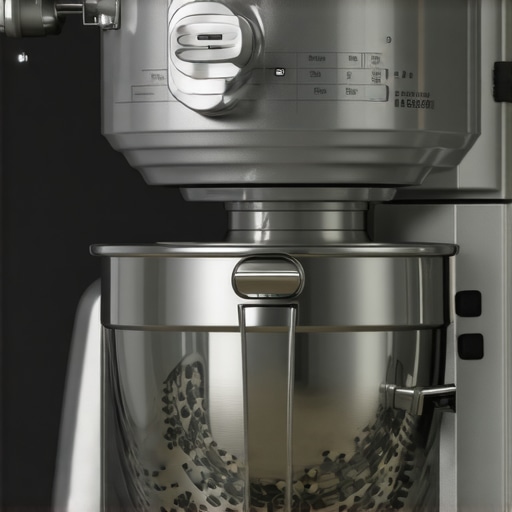
Buying a $1,000 appliance for a luxury kitchen often feels like a guarantee of quality. It is not. After fifteen years of tearing down appliances and identifying why the industry’s highest-priced models fail, I have learned one hard truth: you are not paying for the shiny powder-coated finish. You are paying for the gearbox. If that gearbox relies on nylon components or poorly cast zinc, you own a decorative paperweight. The stakes are high for serious bakers. A failed motor during a high-hydration sourdough batch does not just ruin your afternoon; it signals a fundamental engineering failure that most manufacturers hide behind sleek marketing. The smell of ozone in your kitchen is the scent of a dying motor that could have been saved by better metallurgy.
The Heavy-Duty Gear Secret Inside Premium Stand Mixers
The core of any high-end mixer is the planetary gear system. This mechanical arrangement allows the attachment to spin in one direction while the head moves in another, ensuring every millimeter of the bowl is reached. However, the secret lies in the material of the worm gear. Most commercial-grade consumer units now use a sacrificial nylon gear. The idea is that the gear breaks so the motor does not burn out. This is a cost-cutting measure disguised as a safety feature. Truly high-performance machines utilize all-metal gear trains. We are talking about carbon steel and hardened brass. These materials handle the thermal expansion that occurs during a twenty-minute knead without losing their structural integrity. When you consider the kneading speeds that protect the drivetrain, you start to see that the gear ratio is more vital than the advertised wattage. A high-wattage motor with a poor gear ratio simply generates heat, not torque.
Technical reality dictates that torque is the only metric that matters for heavy dough. Manufacturers often brag about 500-watt or 1000-watt motors. This is misleading. If the machine cannot transfer that power to the beater through a solid gear train, that power is wasted as heat. This heat degrades the food-grade grease inside the housing. Once that grease thins, it begins to leak. This is the common cause for machines leaking gray oil into your flour. To prevent this, professional-grade units use a sealed transmission with high-viscosity synthetic lubricants that adhere to the gears even under extreme centrifugal force. Understanding internal gearbox maintenance is what separates a machine that lasts five years from one that lasts fifty. The weight of the machine is your first clue; solid steel gears and a heavy cast-iron housing provide the ballast needed to prevent the head from ‘walking’ across the counter during high-torque operations.
[IMAGE_PLACEHOLDER]
The stress test for these machines is the high-hydration dough. Imagine the motor straining, the gears grinding with a metallic thrum, and the housing growing hot to the touch. This is where the engineering fails. I have seen ‘professional’ mixers with cracked gear housings because the manufacturer used thin-walled aluminum instead of reinforced cast steel. The result? Total mechanical collapse. If your motor decibel increases over time, you are likely hearing the gears slowly grinding themselves into dust due to a lack of precise alignment. According to standards set by the American Gear Manufacturers Association, the precision of gear teeth determines the longevity of any high-torque system. If the teeth are off by even a fraction of a millimeter, the friction creates a feedback loop of heat and wear that no amount of grease can fix.
The Engineering Reality of Thermal Runaway
Thermal runaway in a stand mixer is a silent killer. When the motor works too hard, the internal resistance of the copper windings increases. This generates more heat, which further increases resistance. Without an active cooling fan or a heat-sink-integrated chassis, the motor eventually hits its thermal limit. Modern disruptors in the appliance space are starting to use DC motors instead of traditional AC motors. Why? DC motors provide more torque at lower speeds and generate significantly less heat. This allows for a more compact design without sacrificing the power needed for heavy-duty premium cookware use. This shift is part of a larger trend toward efficiency in the luxury kitchen space, where performance is beginning to catch up to the aesthetic demands of high-end design. Regulatory changes regarding energy consumption are also pushing brands to adopt these more efficient motor types, as noted by the IEEE Standards Association regarding small appliance motor efficiency.
Strategic foresight suggests that the next two years will see a return to repairable engineering. Consumers are tired of throwing away $800 machines. We are seeing a demand for ‘Right to Repair’ features, such as accessible gear ports and replaceable brushes. This is a market correction against the planned obsolescence that has plagued the industry. If you are shopping today, my executive verdict is simple: Buy for the drivetrain. Ignore the digital screens and the Bluetooth connectivity. Look for a machine with a high-torque DC motor, an all-metal gear train, and a solid cast-metal body. If you are a professional baker or someone who handles large volumes, invest in a commercial-certified unit. If you are a home enthusiast, look for models that allow for easy tilt-head adjustments to keep the gears in perfect alignment. The logic is simple: a machine that is built to be serviced is a machine that is built to last.
Frequently Asked Questions
Why does my mixer smell like burning rubber? This usually indicates that the drive belt is slipping or the sacrificial nylon gear is overheating. Stop the machine immediately to prevent motor damage.
Are all-metal gears always better? Yes, for durability and torque. However, they are louder than nylon gears. The noise is the trade-off for a machine that can handle ten pounds of dough without stripping a gear.
How often should I change the grease in my mixer? For heavy users, an internal inspection and grease refresh every three to five years is optimal. This prevents the lubricant from breaking down and leaking.
Does a higher wattage mean a more powerful mixer? Not necessarily. A 300-watt DC motor can often outperform a 1000-watt AC motor in torque delivery. Focus on the motor type and gear construction instead of the raw wattage number.