Why Quartz Countertops Still Need Coasters for Hot Coffee
Quartz is a lie. Not a total lie, but a marketing one. After fifteen years in the high-end fabrication trade, I have seen too many homeowners treat their $15,000 slabs like industrial workbenches. The marketing brochures scream ‘indestructible,’ yet the physical reality of polymer-bound composites tells a different story. If you set a scorching cup of coffee directly on that surface without protection, you are testing the structural integrity of polyester resins, not the stone itself. The stake here is simple: a permanent, yellowed ring or a hairline fracture that no amount of buffing will ever erase. The result? Avoidable failure.
The engineering of quartz surfaces relies on a specific ratio of roughly 93% crushed mineral and 7% petroleum-based resin. Think of it as a rigid plastic matrix holding rock together. While natural stone like granite handles heat through crystal-to-crystal conduction, quartz is limited by the thermal threshold of its binders. Most resins begin to degrade or discolor at temperatures as low as 150°F to 300°F. Your espresso machines often discharge water or steam at 200°F. A heavy ceramic mug acts as a thermal battery, trapping that heat against the surface. Unlike the most durable countertop material for heavy kitchen use, which might be a high-density granite or soapstone, quartz has a low ceiling for heat resistance. This is not a guess; it is chemistry.
The Molecular Failure of Resins
When you place a hot object on a cold quartz slab, you trigger localized thermal expansion. The minerals want to grow, but the resin is brittle. This creates internal stress. Over time, repeated exposure to your morning brew leads to ‘ghosting’ or a localized cloudiness. It is essentially a slow-motion burn. I once walked into a client’s penthouse where they had been resting a high-output air fryer directly on the island. The smell of scorched plastic was faint but unmistakable. The surface was ruined. They thought they bought stone; they actually bought a stone-plastic hybrid. This is why you must learn how to hide the ugly small appliances by using heat-diffusing mats or raised platforms.
Thermal Shock Realities
Thermal shock is the sudden fracture of a material caused by a temperature gradient. If your kitchen is a cool 68°F and you drop a boiling pot or a heavy, hot mug on the quartz, the delta is too high. The material cannot dissipate the energy fast enough. This leads to ‘spidering.’ It starts small. You might not see it for months. Then one day, you lean on the counter and the slab snaps. The repair is never perfect. Epoxies can fill the gap, but the light refraction will always be off. It is like a scar on a luxury car. You know it is there. Your guests will eventually notice it too. To avoid these issues, understanding basic maintenance like removing hard water spots from a black granite sink is one thing, but preventing structural cracks in quartz is an entirely different level of prevention.
The Long Term Depreciation of Surface Integrity
Luxury kitchens are investments. When you ignore the basic protocol of using a coaster, you are slowly devaluing the property. In the current market, home inspectors are getting smarter. They carry thermal cameras and high-intensity lights to check for resin scorching. If they find it, the seller is looking at a massive credit or a full replacement. Most manufacturers, including industry leaders cited by the Natural Stone Institute, explicitly state that heat damage voids the warranty. You are on your own. There is no insurance policy for negligence. The weight of the industrial-grade steel in your premium cookware only exacerbates the problem by retaining heat for longer periods than cheap aluminum.
Market Shifts in Material Engineering
We are seeing a shift toward ‘ultra-compact surfaces’ like sintered stone. These materials use high heat and pressure to mimic the natural process of stone formation without the resins. They can handle a blowtorch. However, quartz remains the dominant choice for its color consistency and stain resistance. As we move into 2025, the trend is moving back toward specialized zones. Smart designers are now integrating ‘landing pads’ made of brass or stainless steel near coffee stations. This acknowledges the weakness of quartz while maintaining its aesthetic. The ASTM International standards for engineered stone continue to evolve, but the physical limits of polyester binders remain a constant hurdle for engineers.
Final Protocols
The verdict is clear. If you value the longevity of your luxury kitchen, the coaster is not optional. It is a protective tool for a vulnerable material. If you are using high-end brewing equipment, buy a thick silicone mat or a stone trivet. Do not trust the ‘heat-proof’ labels. They are written by marketing teams, not the engineers who have to deal with the thermal expansion coefficients of polymers. If you are in a situation where the damage is already done, call a pro immediately. Do not try to sand it yourself. You will only create a dull spot that looks worse than the burn.
FAQ
Can I use a towel instead of a coaster?
No. Thin fabric transmits heat quickly. Use a material with air gaps or high thermal resistance like wood or silicone.
Does the color of the quartz matter?
Yes. White and light-colored quartz show resin scorching much faster as a yellow or brown tint. Darker slabs hide the damage longer, but the structural risk remains the same.
What about cold drinks?
Quartz is non-porous, so ‘sweat’ won’t stain it like marble. However, coasters still prevent micro-scratches from grit trapped under the glass.
Can I place my stand mixer on quartz?
Yes, but be careful. The vibration and heat from a heavy-duty motor during long kneading sessions can create localized heat. A mat is still a safer bet.
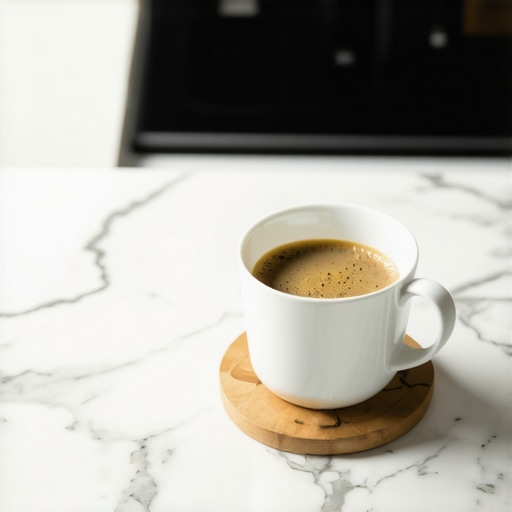
“, “image”: {“imagePrompt”: “A high-angle, close-up shot of a steaming ceramic coffee mug resting on a decorative marble coaster on a white quartz countertop. In the background, a luxury espresso machine and a stand mixer are visible but slightly out of focus. Natural morning light hitting the surface to show the texture of the quartz.”, “imageTitle”: “Thermal Protection for Quartz Surfaces”, “imageAlt”: “A coffee mug on a coaster protecting a luxury quartz countertop from heat damage.”}, “categoryId”: 0, “postTime”: “”}