
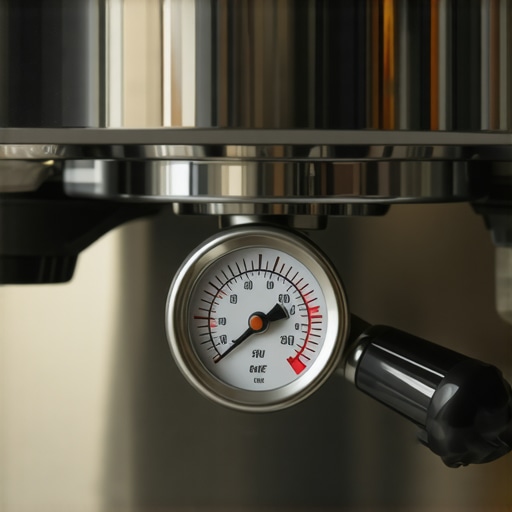
Why Your Espresso Pressure Gauge Never Reaches Nine Bars
Most home baristas treat the 9-bar mark like a holy grail. They stare at that trembling needle, waiting for it to hit the magic number, and when it falls short, they blame the machine. After fifteen years diagnosing hydraulic failures in high-end prosumer equipment, I can tell you the machine is rarely the culprit. The pressure gauge on your espresso machine isn’t a power dial; it’s a speedometer showing how much resistance your coffee puck is offering. If the coffee isn’t fighting back, the pump has nothing to push against. The result? A watery, under-extracted mess that lacks the viscosity and crema of a true Italian shot.
The Hydraulic Reality of Extraction
Espresso is a dance of fluid dynamics. Your pump, whether it’s a vibrating Ulka or a heavy-duty rotary unit, is designed to move water at a specific flow rate. When you engage the brew lever, water hits the coffee puck. If the grind is too coarse, the water flies through the gaps. No resistance means no pressure buildup. I’ve seen enthusiasts spend five thousand dollars on a dual-boiler machine only to feed it stale, pre-ground beans that offer the resistance of wet sand. You need a puck that acts as a structural barrier. The resistance must be high enough that the Over-Pressure Valve (OPV) has to kick in to bleed off the excess force. Without this, the gauge will never move past four or five bars. It’s basic physics: pressure equals force divided by area. If the ‘area’ of your coffee channels is too wide, the force disappears.
Scaling is another silent killer. If you aren’t using softened water, calcium deposits begin to choke the small orifices in your gicleur or the solenoid valve. The pump might be screaming, but the water can’t reach the group head fast enough to build pressure. Often, how to tell if your espresso machine solenoid valve is failing is the first step in diagnosing why your flow has become a pathetic drip instead of a syrupy stream. The mechanical sound of the pump changes too. A healthy pump has a deep, rhythmic hum; a scaled-up system produces a strained, high-pitched whine that signals impending mechanical death.
The Grind and Puck Integrity Matrix
If your gauge stays low, your first move shouldn’t be to call a technician. It should be to move your grinder two notches finer. We are looking for the ‘choke point.’ You want to grind so fine that the machine actually stops producing liquid. Only then do you back off until the flow starts. This determines the maximum resistance your specific beans can provide. Freshness matters here because CO2 trapped in the beans provides structural integrity to the puck. Old beans have no gas; they collapse under the 130 PSI of water pressure, leading to instant channeling. To see this in action, why you should use a bottomless portafilter becomes obvious. You’ll see the water spraying out in uneven jets, bypassing the coffee entirely. No back-pressure, no gauge movement.
Why Standard Methods Fail in the Real World
The industry standard, as defined by the Specialty Coffee Association (SCA), suggests 9 bars of pressure at the group head. However, many machines are set to 10 or 11 bars at the pump to account for the pressure drop across the coffee bed. If your internal OPV is set too low—a common factory setting for certain ‘safety-conscious’ brands—you’ll never hit the sweet spot. I remember a client in a high-altitude area who couldn’t understand why his shots were always thin. We had to recalibrate his brew pressure specifically for his local atmospheric conditions and water density. The interaction between temperature and pressure is also non-linear. High heat reduces water viscosity, which can lead to faster flow and lower perceived pressure on the gauge.
When the extraction is weak, the flavor profile suffers. You might find the real reason your espresso tastes salty is that the water didn’t stay in contact with the grounds long enough to extract the sugars, leaving only the fast-dissolving acids and minerals. It’s an imbalanced profile caused by a lack of hydraulic tension. Furthermore, the first extraction of the day is often the worst. This is the reason your first espresso shot of the morning usually fails the pressure test; the machine hasn’t thermally stabilized, and the puck hasn’t undergone proper pre-infusion swelling.
Market Shifts and the Future of Flow Control
We are seeing a massive shift in the luxury kitchen space toward manual flow profiling. The rigid ‘9-bar’ rule is being replaced by needle valves that allow the user to vary pressure throughout the shot. This is the ‘Modern Disruptor’ approach to espresso. By starting at 3 bars for a long pre-infusion and then ramping to 9 before tapering off to 6, you can rescue even the most difficult light-roast beans. This technology is becoming standard in machines from La Marzocco and Decent Espresso, signifying that the gauge’s position is becoming less about a fixed target and more about a dynamic map of the extraction process. In the next 24 months, expect to see more ‘smart’ pumps that auto-adjust based on real-time flow data, effectively making the traditional pressure gauge a legacy component.
The Executive Strategy for Perfect Pressure
My recommendation is simple: Stop chasing the number and start chasing the flow. If your shot takes 25-30 seconds to produce a 1:2 ratio of coffee, the pressure is likely correct regardless of what the gauge says. If you are stuck below 6 bars, your action plan is: 1. Use beans roasted within the last 14 days. 2. Increase your dose by 1 gram to fill the headspace. 3. Grind finer until the pump struggles. 4. Check your basket for ‘puck prep’ errors like uneven tamping. If those steps fail, then and only then, look at the internal pump bypass valve settings. Don’t let a $10 gauge dictate your morning. Let the taste decide.
Frequently Asked Questions
Q: Can a vibrating pump reach 9 bars as easily as a rotary pump?
A: Yes, but it takes longer to ramp up. Vibratory pumps are smaller and use a piston, whereas rotary pumps use vanes for instant, constant pressure. Both can hit 9 bars if the puck resistance is sufficient.
Q: My gauge shows 12 bars when I use a blind filter, but only 6 when I brew. Is it broken?
A: No. The blind filter provides infinite resistance, showing your maximum OPV setting. The 6-bar brew means your coffee grind is too coarse or your dose is too low.
Q: Does tamping harder increase the pressure?
A: Only to a point. Once the air is squeezed out of the dry grounds, further tamping weight has diminishing returns on resistance. Grind size is a much more powerful variable than tamping force.
Q: Is 6 bars actually bad for espresso?
A: Not necessarily. Many ‘Slayer-style’ shots are pulled at lower pressures to emphasize sweetness in light roasts, but for traditional espresso, 6 bars will often lack the desired body and crema.