
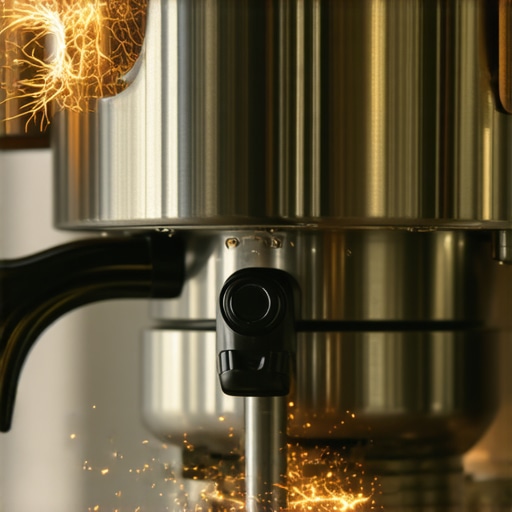
Why Your Espresso Grinder Still Has Static After Cleaning
Most luxury kitchen owners operate under a fundamental misconception: that cleanliness is the primary driver of mechanical performance. You’ve disassembled your $2,000 grinder, scrubbed the chute with isopropyl alcohol, and brushed the burrs until they gleam like surgical tools. Yet, the moment you flip the toggle, coffee grounds erupt in a chaotic, clinging cloud, coating your precision-milled portafilter and expensive marble countertop. The frustration is palpable. After fifteen years of diagnosing high-end coffee equipment and seeing the ‘operational scars’ of failed maintenance routines, I can tell you that a perfectly clean grinder is often the most susceptible to static. Cleaning isn’t the cure. Often, it’s the catalyst for the very chaos you’re trying to avoid.
The physical reality of your espresso grinder is governed by the Triboelectric Effect. This is the transfer of electrons that occurs when two materials—in this case, coffee beans and your grinder’s internals—rub against each other. When you strip every microscopic layer of coffee oil from the burr set, you increase the surface friction and remove the natural insulation that helps dissipate charge. If you’ve noticed that your coffee grinder burrs need replacing sooner than you think, it may be because you’ve been over-cleaning them, leading to increased heat and friction that exacerbates this electrostatic nightmare.
The Physics of Surface Friction
Static electricity isn’t a sign of dirt; it is a sign of energy imbalance. As beans travel from the hopper into the grinding chamber, they undergo rapid fracturing. This mechanical stress strips electrons from the organic matter. In a luxury kitchen environment, where climate control systems often strip moisture from the air, this charge has nowhere to go. Metal burrs are conductive, but the pathways they sit in—often lined with plastic sleeves or anti-popcorn discs—are insulators. The charge builds until it reaches a breaking point. The result? A mess that ignores gravity. If you’ve struggled to fix the grind retention problem in your coffee mill, you’re likely fighting a battle against physics, not just leftovers.
The cost of ignoring this is more than just a messy counter. Static leads to ‘clumping,’ where charged particles bind together. These clumps create density variations in your puck. When 9 bars of pressure hit that coffee, the water finds the path of least resistance. We call this channeling. You end up with a shot that is simultaneously sour and bitter because the extraction is uneven. You can spend thousands on premium cookware and espresso machines, but if your grinder is throwing a static tantrum, your ROI on those beans is zero.
The Failure of Standard Cleaning Protocols
Standard industry advice suggests using ‘grinder cleaner’ tablets. These are essentially compressed starch and binders. While they absorb oils, they also leave behind a bone-dry environment. For the Technical Purist, this is a nightmare. A bone-dry grinder is a high-friction grinder. You need a specific level of ‘seasoning’—the microscopic coating of coffee lipids—to act as a natural lubricant and antistatic barrier. When you deep clean, you reset this seasoning to zero. The first five pounds of coffee after a deep clean will always be more static-prone than the fifth pound. This is an operational reality that national ‘how-to’ guides never mention.
Humidity is the silent variable. According to the Specialty Coffee Association (SCA), environmental factors like relative humidity (RH) can swing your extraction variables by 20% in a single day. If your kitchen is below 40% RH, no amount of cleaning will stop the static. I’ve seen clients in high-rise condos with industrial-grade HVAC systems struggle with this more than anyone else. The air is too ‘clean’ and too dry. You hear the sharp snap of a discharge when you touch the doser. That’s the sound of a technical failure.
The Messy Reality of Implementation
Let’s talk about the ‘clank of the manifold’ and the weight of industrial-grade steel. When you’re working with a heavy-duty prosumer grinder, the components are dense. They hold thermal energy. As you grind, the friction generates heat. Heat lowers the relative humidity inside the tiny micro-environment of the grinding chute. Even if your barista scale is showing weight fluctuations because of static-cling particles, the underlying issue is the thermal-static loop. I once worked on a setup where the client used a hair dryer to ‘warm’ their grinder in the morning. A disaster. The heat just made the static worse, and the coffee tasted like baked cardboard.
The risk here is believing that more tools fix the problem. People buy ‘static needles’ or fancy brushes. They are band-aids. The real solution is managing the moisture at the source. This leads us to the Ross Droplet Technique (RDT). A single drop of water—literally 0.1ml—introduced to the beans before grinding can neutralize the triboelectric charge. It’s a simple, low-tech fix for a high-tech problem. But be careful. Too much moisture and you risk rusting your high-carbon steel burrs or causing the very soggy espresso puck issues you were trying to avoid.
Market Shifts and Strategic Foresight
The industry is moving toward built-in solutions. In the next 12 to 24 months, expect to see ‘Plasma Generators’ become standard in high-end home grinders. These are small ionizers located in the exit chute that flood the coffee path with negative ions, neutralizing the charge in real-time. We are seeing this tech move from industrial manufacturing (where the National Institute of Standards and Technology (NIST) has long used ionization to control static in clean rooms) into the luxury kitchen. If you are in the market for a new grinder, look for ‘neutralization’ or ‘ion-beam’ features. This is the end of the manual RDT era.
We are also seeing a shift in burr geometry. Manufacturers are experimenting with ‘low-friction’ coatings like DLC (Diamond-Like Carbon) or TiN (Titanium Nitride). These aren’t just for durability; they change the surface energy of the metal, making it harder for electrons to jump ship. It’s an engineering response to a biological problem.
The Executive Verdict
If your grinder is currently a static-factory despite being clean, follow this actionable strategy: First, stop over-cleaning. Limit deep chemical cleans to once every three months. Second, implement RDT using a precision spray bottle—one mist for a 18g dose. Third, check your kitchen’s humidity. If you’re living in a luxury space, you need a humidifier to keep the air at 45-50% RH, not just for your coffee, but for your woodwork and your health. If you are in a situation where the static is constant despite these fixes, your burr alignment might be out of spec, causing excessive friction. Sell the old unit and invest in an ionized-chute model. It’s a market correction your morning routine deserves.
Frequently Asked Questions
Does dark roast coffee cause more static?
Yes. Darker roasts are more brittle and have more surface oils that have been brought to the exterior. They fracture more violently, creating more surface area for charge to accumulate compared to denser, light-roast beans.
Will a metal portafilter help ground the static?
Only if the grinder’s cradle is also metal and properly grounded to the electrical circuit. Many ‘luxury’ grinders use plastic cradles for aesthetics, which breaks the grounding path and leaves the static with nowhere to go but your counter.
Can I use a dryer sheet to wipe the chute?
Absolutely not. The chemicals in dryer sheets are toxic and will ruin the flavor profile of your coffee. If you must wipe it, use a damp microfiber cloth to introduce a tiny amount of moisture and conductivity.
Is RDT safe for all grinders?
It is safe for grinders with stainless steel or coated burrs. I would be cautious with vintage grinders using untreated cast iron burrs, as moisture can lead to flash-rusting over time if not used daily.