
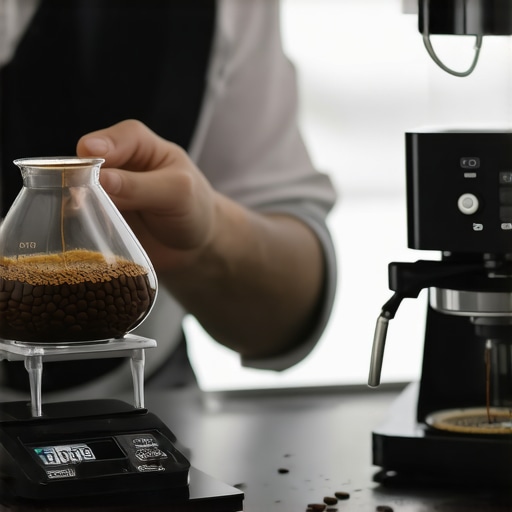
Why You Need a Dedicated Coffee Scale for Truly Consistent Espresso
Stop eyeballing your espresso. If you are relying on the volumetric lines on a shot glass or the timer on your machine to determine when to stop an extraction, you are essentially guessing. After fifteen years of calibrating high-end espresso machines and designing luxury kitchens, I can tell you that the single most common cause of poor coffee in the home is the refusal to weigh the input and output. Precision is not a luxury. It is the baseline. Volumetric measurement is a lie because coffee beans are a biological product. They change. They outgas. A bean roasted five days ago occupies a different volume than the same bean roasted thirty days ago, even if the weight is identical. The result? Inconsistent, frustrating coffee that wastes expensive beans.
The Engineering Reality
Espresso is a game of mass, not volume. When water at 9 bars of pressure hits a puck of coffee, it dissolves solids. The rate of this dissolution is dictated by the surface area of the grind and the density of the pack. Crema, the golden foam on top of your shot, is largely CO2. Fresh beans produce more crema, making a shot look ‘full’ in a glass when it actually lacks the necessary liquid mass. By using a scale, you remove the ‘crema bias.’ You ensure that if you put 18 grams of dry coffee in, you get exactly 36 grams of liquid out. This 1:2 ratio is a standard starting point, but without a scale, you are flying blind. Many enthusiasts struggle with why your espresso tastes like burnt rubber even with great beans, and often the culprit is an over-extended extraction that went five grams too long because it ‘looked’ right. Industry standards from the Specialty Coffee Association (SCA) confirm that mass-based brewing is the only way to ensure repeatability in high-pressure extractions.
[image placeholder]
The ROI of Precision
Think of your espresso setup as a laboratory. You wouldn’t bake a complex souffle without measuring the flour, yet people expect a $3,000 espresso machine to perform magic without data. A dedicated coffee scale provides real-time feedback on flow rate. If your shot hits 36 grams in 20 seconds one day and 30 seconds the next, you know your grind size or distribution is failing. Without that data, you might blame the machine or the beans. This saves money. You stop dumping shots down the sink. You also start to notice the coffee scale feature you are probably ignoring: the auto-timer that starts on first drip. This allows you to track the contact time precisely, which is vital for balancing acidity and bitterness. If you find the reason your first espresso shot of the morning always tastes sour, it is likely a temperature issue or a slight mass deviation that a scale would have caught instantly.
Managing the Messy Reality
The industry likes to pretend that once you have a scale, everything is perfect. It isn’t. Static electricity and humidity are your enemies. On a dry winter morning, your grinder might experience higher retention. This means you put 18 grams in, but only 17.2 grams come out. That 0.8-gram difference is enough to ruin the puck resistance, causing a ‘fast’ shot. You need to weigh the dose before it goes into the portafilter and after. This is the only way to identify if you are how to fix the grind retention problem in your coffee mill. I have seen countless luxury kitchens equipped with premium cookware and espresso machines where the owner ignores this step, then wonders why their coffee tastes like a gas station brew. The ‘operational scar’ here is simple: never trust the grinder’s internal timer. The grind speed changes as the hopper empties and the weight of the beans pressing down on the burrs decreases. This is known as ‘popcorning,’ and it changes your dose weight every single time.
Market Corrections and Future Trends
We are seeing a shift in the high-end kitchen market. The next 18 months will see an explosion of IoT-integrated scales that talk directly to the espresso machine’s brain. However, don’t wait for the tech to become built-in. Most integrated scales in consumer machines are slow and lack the 0.1g sensitivity required for true precision. The Institute of Food Technologists (IFT) has highlighted how precision in extraction affects the bioavailability of caffeine and antioxidants. Professional-grade scales like those from Acaia or Hiroia are the current benchmark. They offer high refresh rates, which is the speed at which the scale updates its reading. A slow scale leads to ‘over-shooting’ your target weight, as the liquid is still falling from the portafilter while the scale is catching up. In a luxury kitchen environment, a scale with a silicone heat mat is mandatory to prevent the heat of the cup from affecting the load cell’s accuracy.
The Executive Verdict
If you are serious about espresso, buy a dedicated scale today. Specifically, look for one with 0.1g resolution, a high refresh rate, and water resistance. My recommendation: Hold off on upgrading your grinder or machine until you have mastered mass-based brewing. If you are currently measuring by volume, switch to mass immediately. You will find that your ‘bad’ beans were actually just ‘badly measured’ shots.
Common Precision Questions
Does any kitchen scale work?
No. Most standard kitchen scales have a 1-gram resolution. In espresso, 0.5 grams is the difference between a sweet shot and a bitter one. You need 0.1g increments.
Why is my scale’s weight drifting?
This is usually due to heat. If you place a hot cup directly on the scale platform without a rubber mat, the heat transfers to the load cell and causes the numbers to climb or fall. Always use a protective barrier.
Should I weigh the beans or the liquid?
Both. Weighing the dry dose ensures your grind is correct. Weighing the liquid output ensures your extraction is stopped at the perfect yield. This ‘dual-weighing’ method is the industry standard for consistency.
“,”image”:{“imagePrompt”:”A close-up, high-angle shot of a sleek, matte black digital coffee scale sitting on the drip tray of a high-end stainless steel espresso machine. A glass demitasse cup sits on the scale, with a rich, syrupy espresso shot flowing into it. The scale’s LED display shows 36.0g with a bright green timer next to it. Soft, natural morning light hits the chrome of the machine and the oily crema of the coffee.”,”imageTitle”:”Precision Coffee Scale on Luxury Espresso Machine”,”imageAlt”:”Digital coffee scale measuring an espresso shot on a premium machine”},”categoryId”:0,”postTime”:””}