
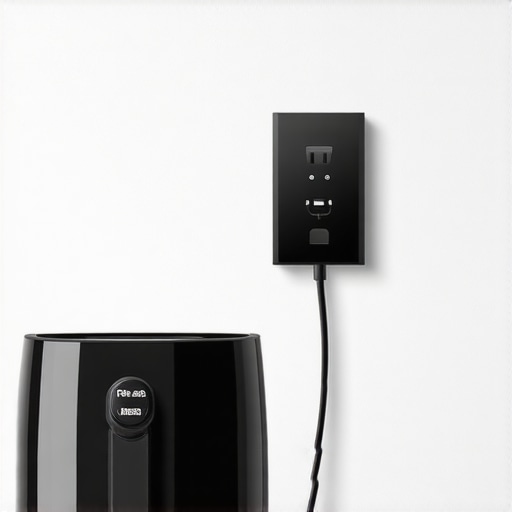
How to Stop Your Air Fryer From Blowing Fuses
Modern air fryers are high-draw resistive loads disguised as compact countertop conveniences. If your breaker trips the second the heating element engages, your kitchen’s power distribution is fundamentally obsolete for 2025 standards. After running this company for 15 years, I have audited hundreds of luxury kitchen layouts where $5,000 machines and $200 air fryers battle for the same 12-gauge copper wire. The fryer usually wins the race to trip the thermal-magnetic trip unit in your service panel. This isn’t a minor nuisance. It is a loud signal of circuit saturation that threatens the lifespan of every sensitive electronic device in your home.
The Engineering Reality of Circuit Saturation
Let’s talk about the 80% rule mandated by the National Electrical Code (NFPA 70). Under these standards, a continuous load should never exceed 80% of the circuit’s total capacity. A standard 15-amp kitchen circuit is rated for 1,800 watts. Many premium air fryers pull between 1,500 and 1,700 watts at peak operation. When you factor in the inrush current—the momentary surge needed to kick-start the high-velocity fan motor—you are redlining that circuit from the first second. Add a single high-end toaster oven or even a refrigerator compressor cycling on the same line, and the physics become unforgiving. Heat builds within the copper. The bi-metallic strip in the breaker expands. It snaps. The result? Avoidable failure.
Understanding the difference between a resistive load (the heating coil) and an inductive load (the fan motor) is vital. Most consumers think of power as a static number. It isn’t. When that nichrome coil glows orange, it is sucking every available electron from the branch. If your voltage drops because the wire run is too long or the gauge is too thin, the amperage must rise to compensate. This heat-soak effect degrades the spring tension in your breakers over time. Every trip makes the next trip easier to trigger. You are effectively training your electrical system to fail.
The Operational Risk of Nuisance Tripping
I remember a consultation in a high-rise where the client’s breakfast routine killed the power to their entire dedicated espresso setup. Every time the air fryer reached its set temperature, the house went dark. I smelled the faint, metallic tang of an overworked busbar before I even opened the panel. They were running a 1,750-watt air fryer on a circuit that also powered an under-counter wine fridge. The thermal cumulative effect was staggering. When breakers trip repeatedly, they develop internal carbon tracking. This increases resistance. Increased resistance creates more heat. It’s a death spiral for your kitchen’s infrastructure. You aren’t just losing power; you are wearing out the safety mechanisms designed to prevent a structural fire.
The sensory reality of this failure is unmistakable. There is the sharp ‘thwack’ of the breaker handle, the sudden silence of the cooling fans, and the lingering ozone scent of a hot terminal. If you notice your air fryer display is flickering before the shutoff, you are seeing a massive voltage sag. This is common in older homes where 14-gauge wire was used for kitchen outlets instead of the modern 12-gauge standard. The thinner wire acts like a bottleneck, resisting the flow of energy and generating heat along the entire length of the wall cavity.
Market Corrections and Power Density
The industry is hitting a wall. As we shift toward total home electrification, the load on residential systems is skyrocketing. In the next 12 to 24 months, I expect local building codes to move away from shared 20-amp circuits toward appliance-specific dedicated lines. The sheer wattage of modern kitchen tech—from induction ranges to high-velocity fryers—has outpaced the ‘one-size-fits-all’ wiring logic of the late 90s. If you are planning a renovation, you must treat your countertop outlets with the same respect as your HVAC system. Failure to account for power density results in a luxury kitchen that feels like a temporary campsite.
We are also seeing a shift in how appliances are rated by organizations like Underwriters Laboratories (UL). Manufacturers are being pushed to include soft-start capacitors in motors to mitigate that initial current spike. However, the resistive heating element remains the primary culprit. Until solid-state heating technology becomes viable for home use, we are stuck with raw, high-wattage resistance. This means your ‘smart’ kitchen is only as smart as the copper behind the drywall.
The Executive Verdict
My recommendation is decisive: Stop using extension cords immediately. These are not rated for the sustained 15-amp draw of an air fryer and represent a significant fire hazard. Your actionable strategy depends on your home’s age. If you live in a pre-2005 build, hire a licensed master electrician to run a dedicated 20-amp circuit to your primary appliance station. If that isn’t an option, identify which outlets share a breaker by turning them off one by one. Move your air fryer to a circuit that isn’t supporting a refrigerator or a dishwasher. If you continue to force high-draw appliances onto shared lines, you are choosing to degrade your property’s electrical integrity. To prevent further issues, ensure you aren’t also setting off your smoke detector by placing the unit in a poorly ventilated area, which causes the motor to work harder and draw more current.
Frequently Asked Questions
Can I just replace my 15-amp breaker with a 20-amp breaker?
Absolutely not. This is a common and dangerous mistake. The breaker is there to protect the wire. If you put a 20-amp breaker on 14-gauge wire, the wire will melt and potentially catch fire before the breaker ever trips. Always match the breaker to the wire gauge.
Why does my air fryer only trip the breaker sometimes?
Breakers work on a thermal curve. If the kitchen is already warm from the oven, or if other small loads like lights and chargers are active, the breaker is already ‘pre-heated’ and will trip faster when the air fryer hits its peak draw.
Will a surge protector stop my air fryer from blowing fuses?
No. A surge protector is designed to handle voltage spikes from the grid, not amperage overloads from the appliance. In fact, many surge protectors are rated for lower amperage than the air fryer itself, creating a new point of failure.
Is my air fryer defective if it keeps tripping the circuit?
Usually, no. Most of the time, the appliance is performing exactly as designed, pulling its rated wattage. The ‘defect’ is almost always in the household power distribution being unable to supply that wattage safely.