
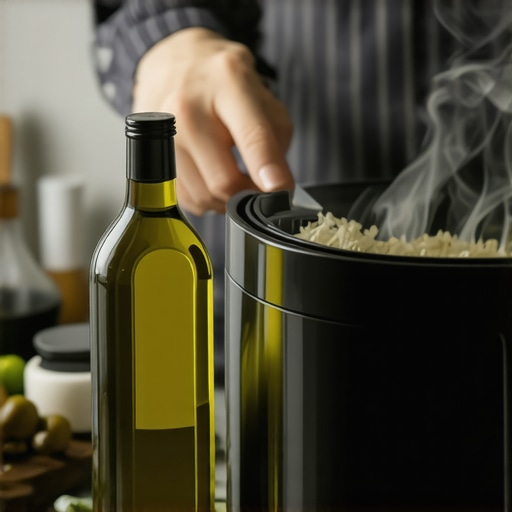
Why You Should Never Use Olive Oil for High-Heat Air Frying
Pouring extra-virgin olive oil into a 400-degree air fryer is a fast track to equipment depreciation and acrid, ruined meals. After fifteen years of diagnosing hardware failures in luxury kitchens, I have seen hundreds of high-end units rendered useless by a fundamental misunderstanding of lipid science. The problem isn’t just the smoke; it is the chemistry of polymerization at high velocity. When you operate an air fryer, you aren’t just baking. You are engaging in a high-speed convection environment that atomizes oil particles. Extra-virgin olive oil (EVOO) carries a low smoke point, typically between 325°F and 375°F. Exceeding this threshold triggers a chemical breakdown, releasing free radicals and a substance called acrolein. This results in that bitter, metallic tang that ruins a $50 dry-aged steak. The stakes are high for your hardware too.
The Thermal Mechanics of Lipid Failure
Air fryers function by circulating superheated air at extreme speeds. This environment accelerates the oxidation of unstable fats. Unlike a deep fryer where the oil volume maintains some thermal mass, the thin coating of oil on your basket is exposed to immediate, brutal heat. EVOO contains a high percentage of free fatty acids. These impurities are what give the oil its flavor, but they also act as the fuse for its destruction. At 400°F, these acids oxidize, creating a sticky, varnish-like residue. This is the same reason the hidden reason your air fryer smells like burnt plastic often points back to old, polymerized oil stuck to the heating element. Once this ‘varnish’ bonds to your non-stick basket or the internal fan housing, it is nearly impossible to remove without abrasive force that voids warranties.
The Physics of the Smoke Point
We need to talk about the flash point versus the smoke point. The smoke point is the temperature at which the oil begins to produce a continuous bluish smoke. In the confined chamber of a luxury air fryer, this smoke isn’t just an eyesore; it’s a pollutant. It coats the sensors and the heating coil. If you ignore this, you’ll find that your unit begins how to fix an air fryer that isnt getting your food crispy enough becomes a frequent search because the thermal transfer is being blocked by a layer of carbonized fat. For high-heat applications, you require an oil with a smoke point north of 450°F. Avocado oil or refined tea seed oil are the technical standards here. They lack the volatile solids that cause EVOO to fail under pressure.
[IMAGE_PLACEHOLDER]
The Operational Risk of Equipment Gunking
Think about the internal fan. It’s a precision-balanced component designed to move air at thousands of RPMs. When you use an oil with a low smoke point, the resulting vapor is heavy with resinous compounds. These stick to the blades. Over time, the balance shifts. The motor draws more current to maintain speed. Eventually, the thermal fuse blows, or the motor burns out. It’s a slow death caused by a ‘healthy’ choice. Many users don’t realize that 5 mistakes that ruin your air fryers non-stick coating permanently often start with the wrong choice of fat. The carbonized oil creates a microscopic ‘sandpaper’ surface that tears at the PTFE or ceramic coating every time you slide the basket in or out.
Market Corrections and Future Trends
The industry is moving toward higher-wattage units with tighter temperature tolerances. In the next 18 months, I expect to see ‘smart’ air fryers equipped with VOC sensors that can detect oil breakdown in real-time and throttle heat to prevent acrolein production. We are already seeing this in prosumer espresso machines and smart ovens. Until that technology is standard, the burden of choice lies with the cook. According to the North American Olive Oil Association, refined olive oil has a higher smoke point than extra-virgin, but it still pales in comparison to avocado oil. Data from the Journal of the American Oil Chemists’ Society indicates that the rate of polar compound formation in olive oil increases exponentially once you cross the 350°F mark in convection environments.
The Executive Verdict
My recommendation is a hard pivot. Stop using EVOO for anything in the air fryer set above 350°F. If you are roasting vegetables at 325°F for a long duration, EVOO is acceptable. For wings, steaks, or anything requiring a Maillard reaction at 400°F, you must use avocado oil or Ghee. The ROI on a $20 bottle of high-quality avocado oil is the saved lifespan of a $400 kitchen appliance. If your unit already has that sticky, yellow film, you are in the danger zone. Switch fats immediately to prevent total hardware failure.
Frequently Asked Questions
Can I use light olive oil instead of extra virgin?
Refined or ‘light’ olive oil has a higher smoke point (up to 465°F) because the volatile solids have been removed. It is safer for the hardware but loses the health benefits and flavor profile people associate with olive oil.
Will using the wrong oil void my warranty?
While hard to prove, technicians can easily identify polymerization damage. If the heating element is coated in carbonized oil residue, many manufacturers will classify this as ‘misuse’ or ‘improper maintenance.’
How do I clean old oil residue off the heating element?
You don’t, at least not easily. Using a soft brush and a non-toxic degreaser when the unit is cold is the only way. Never use steel wool, as a single scratch on the element can lead to hotspots and failure.