
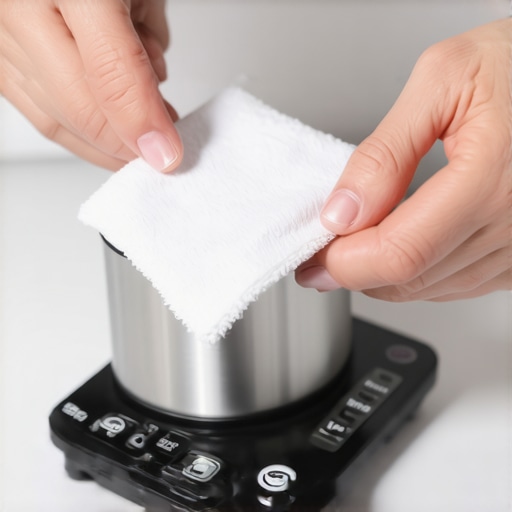
A precision coffee scale is an electronic instrument, not a kitchen utensil. Most owners treat their scales with the same disregard as a plastic measuring cup, and that is exactly why their extractions drift into inconsistency. After managing high-performance espresso labs for over fifteen years, I have seen hundreds of load cells fail due to moisture ingress or physical shock during cleaning. These devices rely on strain gauges measuring micro-voltages; a single drop of liquid in the wrong cavity renders the sensor useless. The mistake is treating the exterior as the only priority while ignoring the sensitive internals that make 0.1g resolution possible. Precision demands a specific technical approach to maintenance that respects the delicate nature of the hardware.
How to Deep Clean a Coffee Scale Without Damaging the Sensors
The core of any scale is the load cell, an aluminum bar equipped with strain gauges that convert physical pressure into electrical resistance. When you spill espresso, the liquid follows the path of least resistance, often seeping through the gap between the weighing platform and the housing. If coffee oils harden inside this gap, they create physical resistance that prevents the platform from moving freely, leading to weight ‘drifting’ or ghost readings. To begin, you must remove the silicone heat mat and clean it separately with warm, soapy water, ensuring it is bone-dry before reassembly. For the scale body, avoid sprays. Capillary action is your enemy. Instead, dampen a microfiber cloth with 70% isopropyl alcohol—this evaporates quickly and dissolves sticky lipids without leaving conductive residue behind. If you are dealing with a failed espresso shot that has flooded the unit, do not shake it. Shaking forces liquid deeper into the electronics. Use a specialized electronic cleaner or compressed air to gently clear the crevices around the buttons and the USB charging port.
The Physics of Sensor Drift
Sensor drift is often a symptom of debris interfering with the beam’s deflection. Even a stray coffee ground wedged under the platform causes significant hysteresis. The technical truth? Most people assume their scale is broken when it simply needs a physical clearance check. High-end scales, much like dual boiler espresso machines, require a controlled environment to function at peak performance. When cleaning, check for ‘bottoming out’—this occurs when residue builds up to the point where the weighing plate contacts the base before the sensor fully deflects. This results in truncated readings that can ruin your recipe. Use a soft-bristled brush to sweep the gap. This is not about aesthetics; it is about maintaining the mechanical clearance required for accurate measurement. According to the National Institute of Standards and Technology (NIST) Handbook 44, the sensitivity of a weighing device is dependent on the absence of friction and environmental interference. In a luxury kitchen environment, steam from nearby appliances can also introduce moisture that fogs the internal display or corrodes the battery terminals.
The Fragility of Load Cell Calibration
The cost of aggressive cleaning is immediate. I once watched a client use a pressurized steam wand to ‘sanitize’ their scale. The heat warped the internal gaskets and permanently shifted the zero-point of the strain gauge. The result? Avoidable failure. Beyond moisture, the biggest risk during cleaning is ‘over-loading’ the sensor by applying too much downward pressure while scrubbing. Most scales have a limit of 2kg. Pressing down hard to remove a stain can exceed this limit, stretching the aluminum load cell beyond its elastic limit. Once the metal is permanently deformed, no amount of software calibration can fix the accuracy. This is why proper tamping technique is done on a tamping mat, never on the scale itself. Always hold the scale by the sides, never by the platform, when wiping it down. If you must use a cleaning agent, ensure it is non-corrosive. Strong detergents can eat through the thin protective coating on the PCB, leading to short circuits weeks after the cleaning event.
Strategic Obsolescence and Hardware Evolution
The industry is moving toward IP67-rated designs that can withstand direct splashes, but we are not there yet for most consumer-grade equipment. In the next 12 to 24 months, expect to see more capacitive touch interfaces that eliminate physical buttons entirely. This reduces the number of ingress points for liquids. However, the trade-off is often lower tactile feedback and potential ghost-triggering in humid environments. The second-order effect of this technological shift is a decrease in repairability. Old-school mechanical scales were easier to service, but modern, sealed units often require total replacement if the sensor fails. For the serious home barista, the investment should be in a scale with a replaceable lithium-ion battery or one that is easily disassembled for deep cleaning. The Specialty Coffee Association (SCA) standards emphasize the importance of precision, and that precision is only as good as your maintenance routine.
The Maintenance Protocol
If your scale is acting up, start with a hard reset. Then, perform a corner test. Place a known weight on each of the four corners of the scale. If the readings vary by more than 0.2g, you likely have debris trapped in the mechanism or a mounting screw has vibrated loose inside the chassis. My recommendation? Buy a 100g or 500g calibration weight and use it weekly. If the scale is off, calibrate it immediately. Do not wait for it to get worse. If you are a high-volume user, consider a secondary, cheaper scale for rough measurements and save your high-precision unit for the final brew. This extends the life of the primary sensor. Clean it dry every day and deep clean with alcohol once a month. This is the only way to ensure your $200 investment lasts a decade rather than a year.
Common Maintenance Questions
Can I use glass cleaner on my scale screen?
Avoid it if the screen is plastic. The ammonia can cloud the surface and seep into the electronics. Use a dry microfiber or a dedicated electronic screen wipe.
Why does my scale weight keep climbing after I stop pouring?
This is usually due to heat transfer or steam. The heat from your carafe is affecting the air pressure inside the scale or warming the load cell. Use a silicone heat mat to insulate the sensor.
Is it safe to store my scale on its side?
Generally, yes, but ensure no pressure is being applied to the platform in the storage position. Constant lateral pressure can eventually affect the sensor’s alignment.