
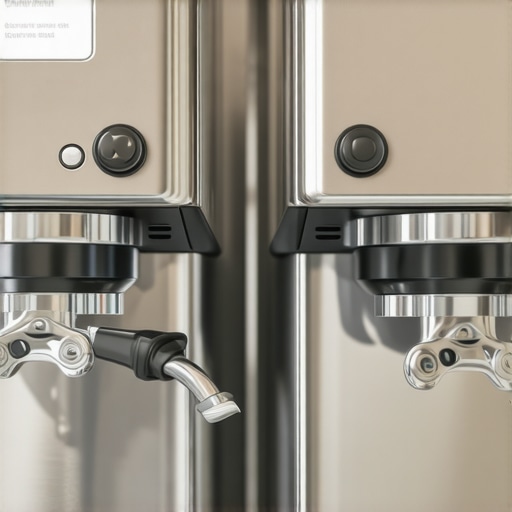
Espresso is a game of thermal consistency, not just pressure. If the water hitting your puck deviates by even two degrees, the flavor profile collapses from a balanced nectar into an astringent mess. Most buyers focus on the shiny chrome, ignoring the physical architecture that dictates their morning cup. After fifteen years diagnosing temperature drift in high-end kitchens, I have seen too many enthusiasts buy into the E61 ‘legend’ only to find themselves frustrated by twenty-minute warm-up cycles. The choice between these two systems is the difference between a cast-iron wood stove and a precision induction burner.
The Difference Between E61 and Saturated Group Heads
The E61 group head is an industry icon. Invented in 1961, it utilizes a thermosyphon system where hot water constantly circulates from the boiler through the group head. This massive nine-pound block of brass acts as a thermal heat sink. It works well because once that brass is hot, it stays hot. However, the E61 is a mechanical beast. It relies on convective currents. If the room is cold or the machine has been idling, the water temperature at the screen might not match what the PID displays. For those debating the technical merits, understanding why espresso machines with PID controllers result in better tasting coffee is essential to managing these thermal offsets.
Thermal Inertia and Boiler Integration
Saturated group heads represent the modern engineering response to E61 limitations. In a saturated system, the group head is physically an extension of the boiler itself. The group is open to the boiler, meaning it is literally ‘saturated’ with hot water. There is no transit time. No convective loop to fail. When you engage the pump, the water hitting the coffee is identical in temperature to the water in the boiler. This eliminates the ‘flash boiling’ often seen in E61 machines where the first few ounces of water are too hot because they have been sitting in the heat exchanger too long. If you are choosing a machine today, you must decide if you value the classic aesthetics of the E61 or the surgical precision of a saturated design. Many homeowners find themselves struggling when they how to choose between a heat exchanger and a dual boiler machine because the group head type often dictates the overall boiler layout.
The Engineering Reality of Thermal Recovery
The cost-benefit analysis of these systems boils down to recovery time and throughput. An E61 machine requires 25 to 45 minutes to fully stabilize. You cannot rush physics. Even if the boiler is at pressure, that brass block is still cold. If you pull a shot too early, the brass will leach heat from the water, resulting in a sour, under-extracted mess. Saturated heads, often found in brands like La Marzocco or Slayer, are ready in ten minutes or less. They are designed for high-volume environments where back-to-back shots are the norm. The technical truth? The E61 is a beautiful, forgiving system for the slow-paced home barista, but it is an inefficient relic compared to the saturated alternative. According to standards set by the Specialty Coffee Association, temperature stability within 1 degree Celsius is the benchmark for professional-grade extraction.
Implementation risks are real. The messy reality of the E61 is the scale. Because it relies on a narrow thermosyphon loop, a single flake of calcium can stall the convective flow. I have stood in luxury kitchens where the machine is pressurized, but the group head is stone cold. The culprit? A clogged 3mm orifice. You hear the pump strain, a faint metallic clank of the manifold, and then nothing. Saturated heads are less prone to this specific failure but are far more complex to service. Replacing a gasket in a saturated head often requires draining the entire boiler. When things go wrong, you want to know how to properly descale a high-end dual boiler espresso machine before mineral buildup ruins a five-thousand-dollar investment.
Future Trends in Thermal Management
The industry is shifting toward ‘saturated-light’ designs—smaller, high-wattage group heads with independent heating elements. We are seeing a move away from massive brass blocks that waste energy. Modern regulatory changes regarding appliance energy consumption in the EU and North America are making the 24/7 idling of an E61 machine less viable. In the next 24 months, expect to see more ‘smart’ group heads that use predictive algorithms to pulse heating elements based on flow rate. This second-order effect will make high-end espresso more accessible but will also make these machines more dependent on stable power. This is exactly why you need a dedicated circuit for your espresso setup to prevent voltage drops from affecting your PID’s accuracy.
Executive Verdict
Buy an E61 machine if you enjoy the ritual of coffee, appreciate mid-century Italian design, and have the patience to let a machine warm up properly. It is a ‘Hold’ for those seeking professional-grade speed. Sell the idea of the E61 if you are a data-driven enthusiast who wants shot-to-shot repeatability. For the modern luxury kitchen, the saturated group head is the ‘Buy.’ It offers the precision required for light roast specialty beans and the efficiency demanded by a modern lifestyle. If you are building a coffee bar today, prioritize thermal stability over chrome plating.
Frequently Asked Questions
Does an E61 group head always require a cooling flush?
In heat exchanger models, yes. The water in the loop gets too hot while idling. In dual boiler E61 machines, the flush is less about temperature and more about clearing old grounds from the screen.
Why are saturated group head machines so much more expensive?
The manufacturing complexity of welding or casting a group head directly into a stainless steel boiler is significantly higher than bolting a standalone E61 unit to a faceplate.
Can I convert an E61 to a saturated head?
No. The entire chassis and boiler plumbing are fundamentally different. It is like trying to turn a naturally aspirated engine into a twin-turbo; you are better off buying the right machine from the start.
How often do I need to service a saturated group?
The gaskets and screens should be checked every six months. Because the group is part of the boiler, any leak can lead to internal corrosion more quickly than with an external E61 mount.