
How to Season a New Carbon Steel Crepe Pan for Non-Stick Results
Buying a high-end carbon steel crepe pan is a commitment to culinary precision, not a shortcut to convenience. Most home cooks, accustomed to the disposable nature of PTFE-coated pans, fail to understand that a raw carbon steel pan is a piece of industrial hardware. It arrives in a state of ‘potential,’ protected by a stubborn factory coating that must be purged before any real cooking occurs. After fifteen years of handling premium cookware for searing and delicate pastry work, I have seen more pans ruined by impatient seasoning than by actual use. The stake is simple: a botched seasoning layer leads to a sticky, carbonized mess that ruins your crepes and eventually forces a total strip-down. Success requires understanding the molecular change of lipids into a hard, plastic-like polymer.
The Hidden Factory Shield
Every new carbon steel pan is shipped with a protective layer, usually beeswax or a food-grade industrial oil. This is not for cooking. It is there to prevent oxidation during maritime shipping. If you attempt to season over this layer, your patina will never bond to the iron. The result? Flaking. I’ve watched clients attempt to ‘cook off’ the wax, only to fill their luxury kitchen with acrid smoke and a yellowed residue that resists all soap. You must use the hottest water your hands can stand. Scrub. Use a stiff brush. If the water stops beading and the steel looks dull and grey, you have reached the raw metal. This is the only time soap is allowed near your pan. Dry it immediately on a burner. Rust is the silent killer of the molecular bond, and it starts in seconds on bare, wet steel.
The Polymerization Science
Seasoning is not about ‘flavoring’ the metal; it is about lipid oxidation and polymerization. When you heat a thin layer of oil past its smoke point, the fatty acids cross-link and bond to the surface of the steel. This creates a hydrophobic barrier. Not all fats are equal. While many suggest flaxseed oil, its high omega-3 content makes the resulting layer brittle. It looks beautiful for a photo, then it chips. Instead, use grapeseed oil or highly refined lard. These provide a minimum standard for luxury cookware performance by creating a flexible but hardy film. The American Chemical Society notes that the drying of oils is an autoxidation process that requires oxygen, heat, and time. If you rush the heat, you get carbonization (char) instead of polymerization (plasticity).
[IMAGE_PLACEHOLDER]
The Thin Film Requirement
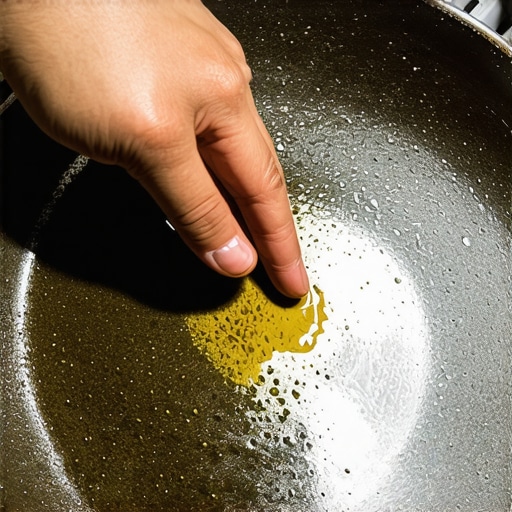
The most frequent error is the ‘puddle’ mistake. You think more oil equals more non-stick. It is the opposite. You need to apply oil and then try to wipe it all off with a clean paper towel. You want a layer only a few molecules thick. If the pan looks wet, there is too much oil. When you heat a thick layer, it turns into a brown, tacky ‘gloop’ that never hardens. I’ve seen thousand-dollar ranges stained by the runoff of over-seasoned pans. Heat the pan until it changes color. First, a straw yellow, then a vibrant blue, and finally a dark grey. This ‘bluing’ of the steel is a form of controlled oxidation that actually helps the oil bond. If you have noticed why your carbon steel pan keeps losing its seasoning, it is usually because the initial layers were too thick to adhere to the smooth metal.
The Thermal Shock Protocol
Carbon steel is responsive. That is why professionals love it. However, this responsiveness makes it prone to warping if you apply high heat to a small area. When seasoning on an induction or electric cooktop, you must ramp up the temperature slowly. A sudden blast of 500 degrees on a 2.5mm crepe pan will dish the bottom. Once the pan is hot and the oil has smoked off, let it cool naturally. Do not quench it in water. The ‘clank’ of a warping pan is a sound you won’t forget. Repeat the oil-wipe-smoke cycle at least three times before the first crepe ever touches the surface. Each layer builds the ‘patina’—a living surface that improves with every use. According to technical reports from Cook’s Illustrated, a well-seasoned carbon steel surface can rival the slickness of any synthetic coating.
Managing Heat and Lipid Oxidation
Once seasoned, your heat management must change. You are no longer cooking on metal; you are cooking on a layer of hardened oil. Excessively high heat can burn off your seasoning, while acidic ingredients like lemon juice or wine will dissolve it. For crepes, the temperature needs to be consistent. If you see the seasoning starting to look dry or matte, it’s time for a maintenance wipe. If you ever find yourself needing to remove burnt-on carbon, avoid abrasives. Use a salt scrub or a chainmail scrubber specifically designed for seasoned metal. The goal is to remove the food without stripping the polymer.
Market Corrections and Future Tech
The luxury kitchen sector is seeing a massive shift away from ‘forever chemicals.’ Consumers are realizing that a pan that lasts 50 years is a better investment than one that lasts two. We are seeing a return to heirloom materials. In the next 12 months, expect more manufacturers to offer ‘pre-blued’ pans that have undergone industrial-scale heat treatment to simplify the home seasoning process. However, the manual seasoning process remains the gold standard for those who demand total control over their equipment’s surface tension.
The Executive Verdict
If you are serious about your kitchen, buy the raw steel. Avoid the ‘pre-seasoned’ shortcuts that often use low-quality oils. Scrub the factory wax like your reputation depends on it. Apply the thinnest possible layer of grapeseed oil. Heat until the steel shifts color. Repeat thrice. If your pan feels sticky, you used too much oil; scrub it back and start over. A properly seasoned crepe pan should allow a delicate batter to slide with a mere flick of the wrist. No shortcuts. Just physics.
Frequently Asked Questions
Can I use soap on my seasoned crepe pan?
After the initial cleaning, avoid dish soap. It contains degreasers designed to break down the very oils you worked to polymerize. Use hot water and a brush.
Why did my pan turn black in some spots and remain silver in others?
This is normal. Seasoning is rarely perfectly even at first. As long as the surface is smooth to the touch, the color does not matter. The deep black comes with months of use.
What do I do if my seasoning starts flaking off?
Flaking usually means the oil was applied too thickly or the factory wax wasn’t fully removed. Use a stainless steel wool pad to scrub off the loose bits and apply two fresh, thin layers of seasoning.
Is flaxseed oil the best for seasoning?
No. While it hardens quickly, it is too brittle for the thermal expansion of carbon steel. It tends to flake off in large sheets over time. Stick to grapeseed or canola oil.