
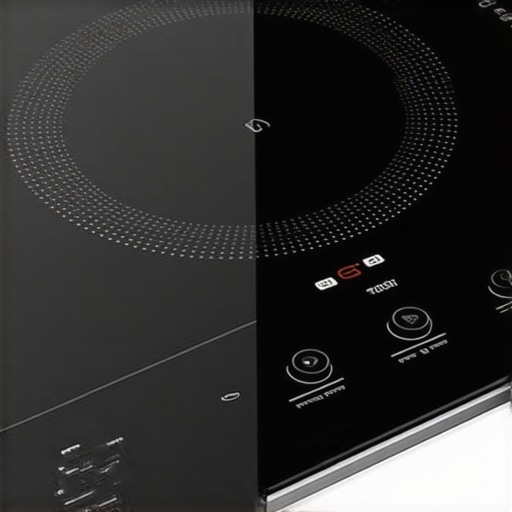
Why Your Induction Cooktop Makes That Annoying Humming Noise
You spent thousands on a high-end induction range. You expected the silence of a precision laboratory. Instead, you get a persistent, high-pitched hum that sounds like a miniature power substation. This isn’t a defect in your appliance; it is a physical byproduct of Lorentzian forces and electromagnetic resonance. After two decades in the luxury appliance sector, I have diagnosed this ‘symptom’ for hundreds of frustrated homeowners. The noise is rarely the cooktop. The noise is the pan. Specifically, the noise is the friction between layers of bonded metal in your cookware vibrating thousands of times per second.
Understanding the physics is the only way to mitigate the sound. Induction cooking works by using a copper coil to create a high-frequency electromagnetic field. This field induces eddy currents within the ferromagnetic base of your pan. If you are using multi-clad cookware—which most premium kitchens do—you are dealing with the real difference between 3-ply and 5-ply premium cookware. These layers of stainless steel and aluminum are bonded together under immense pressure. However, they are not a single solid piece. Under the stress of a 20-50 kHz magnetic field, these layers can vibrate against each other. The result? A shrill, audible hum.
The Physics of Harmonic Resonance
The noise often changes pitch when you adjust the power level. This happens because the cooktop uses Pulse Width Modulation (PWM) to control heat. At lower settings, the ‘clicking’ you hear is the magnetic field cycling on and off to maintain a specific temperature. At high settings, the continuous oscillation of the field pushes the pan’s structural integrity to its limit. If the pan has a lower mass or poorly bonded layers, it becomes an unintended speaker. Heavy-duty cast iron or carbon steel rarely hums. Their monolithic structure lacks the internal gaps required for parasitic oscillation. If you are chasing the secret to steakhouse searing on a home induction hob, you must accept that thin, layered pans will always protest more than solid iron.
The Engineering Reality
Designers at companies like Miele and Wolf attempt to dampen these vibrations through high-mass coil assemblies. Even the best engineering cannot overcome the laws of electromagnetism. The Institute of Electrical and Electronics Engineers (IEEE) notes that induction heating efficiency relies on this rapid oscillation, which inherently creates mechanical stress on the cooking vessel. If your pan is lightweight, it moves more. If it is warped, the air gap between the glass and the metal creates a rattle. This is why you often notice the reason your pan-fried fish always sticks to stainless steel is often related to uneven heat distribution caused by these same structural pan flaws.
[IMAGE_PLACEHOLDER]
Market Corrections and Consumer Risk
The industry is shifting toward thicker 7-ply constructions to reduce noise, but this adds weight and cost. Low-end ‘induction-ready’ pans often use a thin magnetic disk sprayed onto the bottom of an aluminum pan. These are the loudest offenders. They fail the thermal stress test within months. As the local market moves toward full electrification, the operational risk for homeowners is buying expensive appliances and pairing them with substandard ‘compatible’ cookware that degrades the experience. National standards set by the National Electrical Manufacturers Association (NEMA) ensure the appliance is safe, but they do not regulate the ‘pleasantness’ of the acoustic profile.
The Executive Verdict
If you want silence, buy heavier pans. Cast iron is the gold standard for acoustic dampening. If you insist on stainless steel, look for 5-ply or 7-ply options with a significant weight-to-volume ratio. My strategy? If a pan feels light for its size, it will hum like a beehive on your induction hob. Avoid using the ‘Boost’ mode for extended periods, as this maximizes the oscillation frequency and the resultant noise. Transitioning your kitchen to high-mass cookware is the only permanent fix for a noisy induction setup.
Frequently Asked Questions
Is the humming noise dangerous? No. It is simply the mechanical vibration of the pan’s layers or the cooling fan of the cooktop working to dissipate heat from the electronics.
Why does the noise stop when I lift the pan? Lifting the pan breaks the magnetic circuit. The eddy currents cease immediately, stopping the vibration in the metal layers.
Does every induction cooktop hum? All induction cooktops produce some level of sound due to the internal cooling fans and the electromagnetic field, but the intensity is largely dictated by the cookware choice.
Will a silicone mat reduce the noise? It might dampen the physical rattle of a warped pan against the glass, but it will not stop the internal humming of the pan layers themselves.