
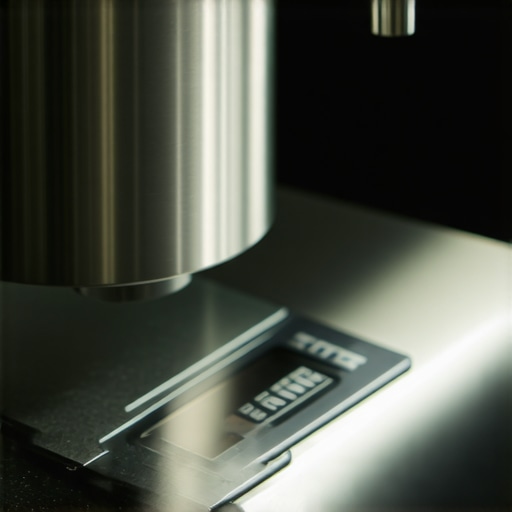
The Precision Scale That Actually Fits Under a Portafilter
Stop guessing your yield. If your scale requires balancing your cup precariously on the edge of the drip tray, your workflow is fundamentally broken. After 15 years designing luxury kitchens and calibrating high-end espresso machines, I have seen five-figure setups rendered useless by a single ergonomic oversight: the Z-axis clearance. A scale that is too thick forces you to use shorter cups or remove the drip tray grate, both of which are unacceptable compromises in a precision environment. Weight is the only objective metric we have for flavor consistency. Without a low-profile, high-frequency response scale, you are flying blind.
The Engineering Reality of Load Cell Sensitivity
The physics of a kitchen scale involve a strain gauge—a small metal bar that bends slightly under weight. In cheap scales, these sensors are sluggish. They suffer from ‘drift,’ where the numbers continue to climb even after the flow has stopped. When you are pulling a 36-gram shot in 28 seconds, a half-second delay in the display means a 2-gram overage. That is the difference between a balanced extract and a bitter mess. High-end espresso machines often have limited space between the portafilter spouts and the grate. Integrating a scale here requires a chassis height of less than 15mm. This isn’t just about aesthetics; it is about preventing the hidden reason your espresso extraction is uneven every morning. Precise measurement is the bedrock of repeatability. If you cannot fit the scale under the group head, you cannot measure real-time flow rate, and your consistency dies.
The Cost of Geometric Failure
Investing in luxury kitchen equipment like premium stand mixers or espresso machines requires a commitment to the technical requirements of those tools. I’ve seen clients spend thousands on a machine only to struggle because their scale is a behemoth designed for weighing flour, not shots. The result? Avoidable failure. When the scale is too tall, the portafilter hits the rim of the cup, or worse, you skip the scale entirely and rely on volume. Volume is a liar; crema density varies by bean age and roast profile. You need mass. Real-world testing shows that a dedicated espresso scale with a 0.1g resolution and a fast sampling rate is the most significant ROI you can find in the hobby. It directly addresses the puck prep mistake that causes constant channeling by ensuring your dose is accurate to the milligram before you even tamp.
The Messy Reality of Steam and Spills
Kitchens are hostile environments. Steam, hot water, and fine coffee dust are the enemies of electronics. I remember a project in a high-humidity coastal home where the client went through three scales in six months. The ‘smell of fresh adhesive’ from cheap gaskets was the first sign of trouble. Moisture ingress eventually fried the motherboards because the scales weren’t sealed for the ‘wet’ environment of a drip tray. A professional-grade scale must have a hydrophobic coating or a silicone heat mat to survive the ‘clank’ of a 58mm stainless steel portafilter. It’s the same logic we apply when we explain the only way to fix a clogged espresso portafilter basket: you need the right tool for the specific mechanical challenge. If your scale isn’t water-resistant, it is a ticking time bomb.
Market Corrections and the Future of Integration
The industry is moving toward total integration. Over the next 12 to 24 months, we will see more espresso machines with built-in gravimetric technology, effectively removing the need for an external scale. However, for those with existing high-end hardware, the move is toward Bluetooth-connected, ultra-thin scales that sync with flow-profiling apps. This allows you to track your ‘shot curve’ in real-time. Regulatory standards for weighing instruments, such as those outlined by the National Institute of Standards and Technology, emphasize the need for stability and repeatability. As home espresso matures, the ‘standard’ scale will shift from a bulky plastic box to a sleek, metallic slab that disappears into the machine’s architecture.
The Executive Verdict
My recommendation is a hard ‘Buy’ on any scale under 20mm in height with a sampling rate of at least 20Hz. If you are using a commercial-style E61 group head, clearance is your primary constraint. Skip the multi-purpose kitchen scales. They are too slow and too fat. Instead, look for a dedicated low-profile unit with a rechargeable lithium-ion battery and a sealed chassis. An actionable strategy for 2025: measure your clearance from grate to spout, subtract 50mm for your tallest cup, and that is the maximum height your scale can be. Anything more is a workflow bottleneck. This level of precision is why we also advocate for specialized maintenance, such as knowing why your espresso tastes metallic and the simple water fix that often accompanies hardware upgrades.
Frequently Asked Questions
Does 0.1g accuracy really matter? Yes. In a standard 18g dose, a 0.5g variance is nearly 3% of the total mass, which significantly alters the resistance during extraction. Why are espresso scales so expensive compared to food scales? You are paying for the sampling frequency and the heat/water resistance required to sit directly under a brewing group. Can I use a jewelry scale? Only if you want it to die within a week. Jewelry scales lack the water protection and the ‘tare-on-start’ features necessary for a wet coffee environment. How often should I calibrate? Every two weeks or if you move the scale. Load cells are sensitive to temperature changes and physical shocks.