
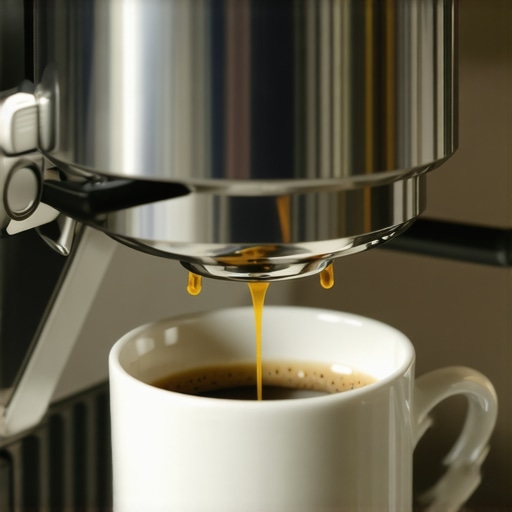
The Hidden Reason Your Espresso Extraction is Uneven Every Morning
Most home baristas obsess over the grind setting while ignoring the hydraulic reality of their machine. After fifteen years of diagnosing high-end espresso machines and designing luxury kitchen layouts, I have identified a recurring mechanical failure. It is not the beans. It is not the user. It is the thermal instability of the brew group and the degradation of the dispersion screen. When you invest in premium cookware and prosumer equipment, you expect consistency. The reality? Fluid dynamics do not care about your budget. Water follows the path of least resistance. Always. If your dispersion screen is partially occluded by polymerized coffee oils, the hydrostatic pressure becomes localized. This creates high-velocity streams that burrow through your coffee bed. This is the technical truth: your expensive setup is only as effective as its cleanliest component. Failing to maintain this small stainless steel disc leads to catastrophic channeling. The result? A shot that is simultaneously sour and bitter.
Fluid Dynamics and Brew Group Saturation
Understanding the physics of the brew head is fundamental for anyone serious about espresso. Most prosumer machines utilize an E61 group head or a saturated group design. The E61 relies on a thermosyphon to maintain heat. If the internal gaskets are dry, the flow rate fluctuates. You might notice why your espresso shots always start with a messy spray during the first five seconds of the pull. This is often a symptom of air pockets within the group head or a calcified mushroom valve. In the world of industrial-grade engineering, we call this flow-path interference. Precision requires a laminar flow. When water exits the dispersion block, it should move like a gentle rain, not a jet wash. If you see ‘tiger stripes’ that appear only on one side of your bottomless portafilter, your machine’s level might be off, or more likely, your screen is finished. Many owners overlook the puck prep mistake that causes constant channeling, but even the best prep cannot overcome a mechanical bias in the water delivery system.
[image_placeholder]
The Engineering Reality of Thermal Bridging
Thermal bridging occurs when the heat from the boiler fails to reach the portafilter evenly. This is particularly prevalent in cold climates where the ambient air in a luxury kitchen sucks the heat out of the exposed group head. A cold portafilter acts as a heat sink. It drops the water temperature by ten degrees the moment the pump engages. This temperature swing stops extraction in its tracks. It is why you must understand why your espresso machine takes so long to heat up before you even think about grinding. I have seen clients try to fix this by increasing the PID temperature. That is a mistake. You are simply scorching the top of the puck while the bottom stays under-extracted. You need thermal equilibrium. The weight of the industrial grade steel in a high-end machine is there for a reason: thermal mass. Use it. Leave the portafilter locked in the group for at least twenty minutes. Anything less is just guessing.
Implementation Risks and The Messy Reality
I remember a service call for a local estate. The client had the finest air fryers and stand mixers, but their espresso tasted like copper. I opened the machine and the smell of fresh adhesive from a cheap aftermarket gasket hit me immediately. They had tried to save twenty dollars on a part for a five-thousand-dollar machine. The gasket had petrified, causing a pressure leak that bypassed the puck entirely. You could hear the hiss of the boiler straining to compensate. This is the operational risk of DIY repairs without technical depth. When a gasket fails, the pressure drops, and the pump works overtime. This leads to premature motor failure. If you are hearing a high-pitched whine, you might need to fix a leaking steam wand on a prosumer machine before the internal moisture ruins the control board. According to the Specialty Coffee Association (SCA), water quality and machine maintenance are the two most ignored variables in home brewing. Neglecting these is an expensive gamble.
Market Corrections and Regulatory Shifts
Looking ahead 12 to 24 months, we are seeing a shift in the high-end appliance market toward more energy-efficient boilers. Local regulations regarding lead content in brass fittings are also tightening. This means manufacturers are moving toward stainless steel boilers. While stainless is more resistant to corrosion, it has different thermal properties than copper or brass. The ‘old guard’ of machines will become harder to service as parts become specialized. We are also seeing a move toward ‘smart’ pressure profiling. These systems use algorithms to detect channeling in real-time and adjust the flow. It is impressive tech, but it adds another layer of complexity that can break. As a founder, I advise sticking to mechanical simplicity where possible. A well-built manual lever machine will outlive a computer-controlled unit every time.
The Executive Verdict
If your extractions are uneven, stop changing your grind. First, inspect the dispersion screen. Second, verify the group head temperature. Third, ensure your machine is perfectly level. I recommend a ‘Buy’ on high-quality precision baskets and a ‘Sell’ on any accessories that claim to fix extraction through gadgets alone. Your actionable strategy is simple: backflush with a detergent weekly and replace your gaskets every six months. Do not wait for a leak. Prevention is cheaper than a full boiler rebuild. For those looking to upgrade, prioritize machines with saturated groups for the best thermal stability.
Frequently Asked Questions
Why does my espresso taste salty despite a good shot time?
Salinity usually indicates severe under-extraction. Even if the time is right, the temperature might be too low. Check your PID settings or your machine’s warm-up time.
How often should I replace my dispersion screen?
In a home environment, every twelve months is standard. If you use dark, oily roasts, every six months is better to prevent polymerized oil buildup.
Can I use tap water in my prosumer machine?
Unless you have a dedicated filtration system that manages TDS (Total Dissolved Solids) and calcium, do not use tap water. Scale is the silent killer of espresso boilers.
Why is my puck soggy after the shot?
A soggy puck often means there is too much headspace between the coffee and the screen. Try increasing your dose or using a smaller basket to ensure the three-way solenoid can vacuum out the excess moisture properly.