Why Heavy-Bottomed Pots Prevents Scorched Sauces
Thin cookware is a deception. It promises speed but delivers destruction. After twenty years in high-end kitchen design and appliance testing, I have seen more ruined holiday meals and warped pans from thin-bottomed pots than from any other equipment failure. The problem is not the cook. The problem is the physics of heat. When you apply a high-BTU flame or an intense induction field to a thin sheet of metal, the energy passes through with violent speed. There is no buffer. No regulation. The result? Avoidable failure. A scorched ring of carbonized dairy at the bottom of your bechamel that no amount of whisking can recover.
The Engineering Reality of Thermal Diffusion
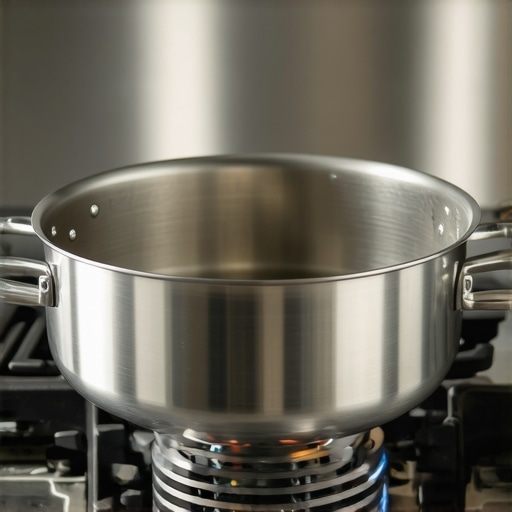
Heat does not move in a straight line; it migrates. In a thin-bottomed pot, the heat from the burner stays exactly where the burner touches. These are ‘hot spots,’ and they are the enemy of emulsion. A heavy-bottomed pot utilizes thermal mass to spread that energy horizontally before it ever moves vertically into your ingredients. We call this lateral conduction. High-end manufacturers achieve this through cladding—layering metals with different properties to create a unified heat engine. If you want to understand the mechanics, you need to look at the real difference between 3-ply and 5-ply premium cookware. A thicker base acts like a capacitor in an electrical circuit. It stores the energy and releases it at a consistent, predictable rate. This prevents the rapid temperature spikes that cause proteins to bond instantly to the steel surface.
Consider the copper core. Copper has a thermal conductivity rate roughly twenty times higher than stainless steel. By sandwiching a heavy plate of copper or aluminum between layers of steel, we force the heat to distribute across the entire diameter of the vessel. This is why 3 reasons copper core pans beat solid copper for modern kitchens are frequently cited by technical purists. You get the responsiveness of copper without the maintenance nightmare or the structural instability of thin-walled vessels. The weight of industrial-grade steel provides the necessary downward pressure to maintain full contact with the cooktop, ensuring that the thermal bridge remains unbroken and efficient.
The Scorch Point and Molecular Stress
When you are working with delicate sauces, you are managing a narrow window of molecular stability. Think of a custard. If the bottom of the pan exceeds the coagulation temperature of the egg yolks by even a few degrees, you are no longer cooking; you are scrambling. In a cheap, thin pan, the temperature at the contact point can fluctuate by 50 degrees in seconds as the burner cycles. In a heavy-bottomed pot, that fluctuation is dampened by the metal’s sheer mass. The weight matters. The density matters. You can even use the egg test to verify how your pan handles heat distribution before committing to a complex sauce. I have stood in commercial kitchens where the smell of fresh adhesive from cheap cabinet installs mixed with the acrid stench of a scorched demi-glace. It is a sensory reminder that shortcuts in equipment lead to disasters in output.
Strategic Foresight for the Modern Kitchen
The industry is moving toward high-output induction. Within the next 24 months, standard gas ranges will face increased regulatory pressure in many jurisdictions, making precision induction the new luxury standard. Induction requires magnetic materials with significant mass to prevent ‘coil whine’—that high-pitched squeal caused by thin metals vibrating at high frequencies. Heavy-bottomed pots are the only logical investment for this transition. Many pro chefs are trading heavy cast iron for 5-ply stainless because it offers the same thermal stability with far better control. We are seeing a market correction where ‘heavy’ no longer means ‘clunky’; it means engineered precision.
The Executive Verdict
If you are serious about sauce work, the recommendation is a ‘Buy’ on high-gauge, multi-clad stainless steel with a minimum base thickness of 3mm. Avoid anything that feels light or ‘tinny’ to the touch. If you can dent the bottom with a firm thumb press, it is a liability, not an asset. Invest in mass. Your sauces depend on the thermal inertia that only weight can provide. Stop fighting your equipment and let the metal do the regulation for you.
Frequently Asked Questions
Does a heavy pot take longer to heat up? Yes. Because of the thermal mass, it requires more energy to reach temperature, but it also stays at that temperature much more reliably once reached.
Is weight the only indicator of quality? Not exclusively. You must ensure the weight comes from functional cladding like aluminum or copper, not just thick, low-conductivity stainless steel.
Can I use these pots on gas and induction? Most modern 5-ply and heavy-bottomed pots are designed with a 430-grade stainless steel exterior, making them fully compatible with all heat sources, including induction.